

Beyond Learning: The Role of L&D in Organisational Change
“Too much change happening!” “Getting managers on board.” “Our company culture doesn’t support change!”
These were among the challenges shared with us at The Learning and Performance Institute (LPI)’s Learning Live 2026 conference, where we invited learning leaders to add their current struggles to our challenge board, one card at a time. The result was a revealing snapshot of what is occupying L&D teams right now.
Some were recognisably learning-focused: building skills, adopting AI, developing capability and helping people work differently. But many pointed to wider challenges: change fatigue, competing priorities, leadership struggles, organisational culture and understanding why change is happening in the first place.
People may need new knowledge or capabilities, but whether they can apply it depends on the conditions around them. Limited capacity, unclear direction, weak involvement or conflicting leadership signals can prevent even well-designed learning from translating into action.
L&D’s remit is clearly stretching beyond learning, with teams becoming increasingly involved in organisational change. This raises a bigger question: where can L&D genuinely make a difference, and where do the solutions require wider organisational action?
The four themes below take a closer look at the challenges shared and what they might mean for L&D’s role in organisational change.
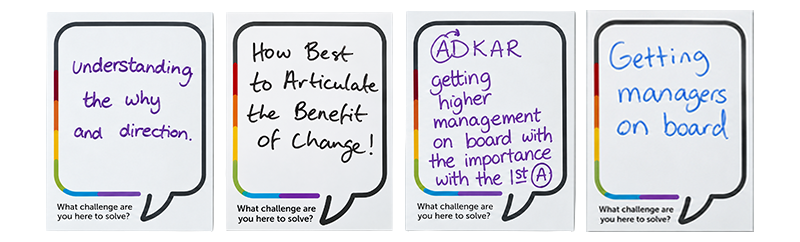
“Understanding the why and direction.”
Clarity about the purpose of change starts with a clear business case: what problem is the organisation trying to solve, what outcomes is it seeking and what benefits should the change create? Without it, gaps can be filled by assumptions, rumours and conflicting interpretations.
If the organisation has not clearly defined the outcomes it wants to achieve, L&D teams can struggle to determine what capability is actually needed. Learning activities can risk being designed around an activity or initiative rather than the behaviour and skills required for successful change.
L&D can help translate organisational direction into clear capability and behaviour requirements by connecting the change to people’s roles, identifying what they need to know or do differently and defining what successful application should look like.
An unclear or shifting business case, inconsistent leadership messaging or decisions that contradict the stated direction will undermine even well-designed learning. Leaders need to provide a consistent story about why the change matters, where it is heading and what is required from people.
Before asking people to learn and behave differently, organisations need to give them clarity about what is changing, why it matters and what it means for them.
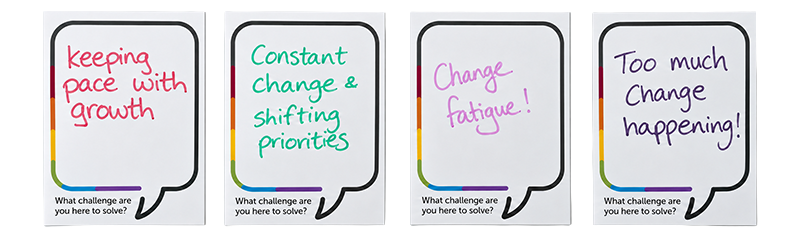
“Too much change happening!”
People may understand what is expected, but lack the time, headspace or support to act on it. When priorities keep shifting, or several changes are happening at once, more tools and resources can become another demand on limited capacity.
L&D teams can identify where change is overloading teams and where learning isn’t translating into practice. L&D can also help organisations build change maturity from within. The principle is much like teaching people to fish: build the capability, tools and confidence that leaders and teams need to navigate change themselves, rather than relying on external support for every new initiative. Organisations that can do this are more likely to adopt change successfully and less likely to suffer from change fatigue.
However, some issues sit firmly outside L&D’s control. Poorly sequenced initiatives, unrealistic workloads and deciding what should stop or slow down require decisions at the organisational level. For example, a team asked to adopt a new system, adjust to a restructure and meet performance targets in the same quarter may receive excellent training and resources, but still have no room to put any of it into practice.
When capacity is the barrier, more learning is not the answer. L&D can build the skills needed for change, but only the wider organisation can create the room to use them.
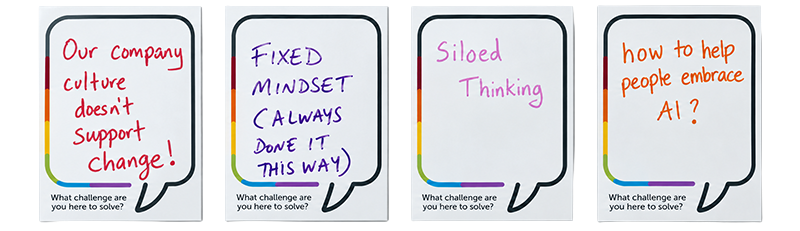
“Our company culture doesn’t support change.”
Learning can give people the skills, confidence and opportunities to practice new behaviours. But whether those behaviours take hold depends on what happens when people return to their day-to-day work. If established routines, competing priorities, incentives and the example set by leaders still favour existing habits, people can quietly revert to what’s comfortable.
The challenge of helping people embrace AI brings this into focus. Teaching people how to use the technology is important, but it is unlikely to change behaviour on its own. People also need clarity about acceptable use, when to apply human judgement and permission to experiment. Leaders make that permission credible through the behaviours they model, the decisions they reinforce and how they keep people engaged through AI-driven change.
L&D can help by creating safe opportunities to experiment, reflect and learn from peers by connecting learning to real workplace situations, helping people build the confidence to challenge established approaches and using feedback from learning activities to surface cultural barriers. This gives L&D an important role not only in developing capability, but also in showing where the working environment may prevent skills from being applied.
However, L&D cannot compensate for leaders modelling contradictory behaviours, silos that stop teams working together or a culture where employees feel that it is unsafe to question existing practices. These conditions require sustained action from leaders and managers, supported by the policies, priorities and decisions that shape everyday work.
Capability may begin with learning, but it only becomes sustained behaviour when the working environment reinforces it.
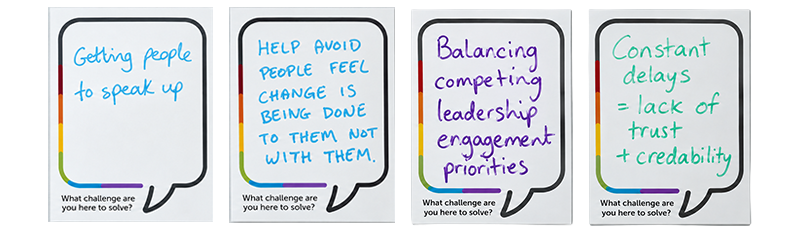
“Getting people to speak up.“
Meaningful engagement takes more than just keeping people informed. People need opportunities to ask questions, contribute their experience and have a voice in how change takes shape.
When change engagement is weak, the instinct can be to communicate more, but more messages do not necessarily lead to greater involvement. If people are only told what is changing rather than given opportunities to explore what it means for their work and contribute to how it is implemented, they can become passive recipients of change.
L&D leaders can help turn communication into participation. Learning interventions can provide space for people to explore what change means for them, practise relevant behaviours and surface questions or practical barriers.
Change programmes need to provide genuine opportunities to contribute, not just ask for feedback. Leaders need to create space for people to speak up and show they have listened to their input. People need to know what has been heard, what has changed as a result and why some suggestions cannot be taken forward.
Communication can build awareness, but involvement is what gives people the opportunity to understand, influence and take greater ownership of change.
Diagnose the Challenge Before Designing the Learning
One card summed up the opportunity for L&D best: get involved before transformation starts. Early involvement gives a clearer view of cumulative demand, emerging capability needs and the support required for delivery. It points to a broader principle: diagnose the challenge before designing the learning.
A useful starting point is to distinguish between three situations:
- A learning need: people lack the knowledge, skills or capability required. L&D can lead the response while managers support application.
- A wider organisational barrier: people may know what to do, but competing priorities, limited capacity, unclear direction, weak sponsorship or the working environment prevent them from doing it. L&D can help surface these barriers and bring them to the attention of those with the authority to address them.
- A shared challenge: capability and the surrounding organisational conditions both need attention. L&D can shape one part of the response, but success depends on coordinated action across the organisation.
For each intervention, agree what people need to do differently, who will address any surrounding barriers and how successful adoption will be assessed.
At Learning Live, we invited delegates to use our 6Lever™ Change Readiness Assessment to look beyond the challenge and explore wider conditions affecting change readiness. By comparing perspectives across Leadership, Drivers, Capability, Method, Engagement and Culture, the assessment can help highlight strengths, potential barriers and areas that may need greater attention during delivery.
The challenge presented to L&D may be about skills, engagement or behaviour, but the solution can sit elsewhere. Looking beyond the presenting challenge can help clarify where L&D can make a difference, where wider business action is needed and, crucially, who needs to take ownership.
What’s really getting in the way of change?
A learning challenge may only be part of the picture. Our 6Lever™ Change Readiness Assessment helps you look across Leadership, Drivers, Capability, Method, Engagement and Culture to identify where your organisation is ready for change and where barriers may need attention.