Free Five Minute Online Diagnostic
Change Readiness Assessment
Receive a personalised change readiness report with practical next actions.

Change Readiness Assessment Tool
Are your people ready for change?
Move beyond assumptions with a structured view of the conditions that may help, or hinder, adoption.
Afiniti’s 6Lever™ Change Readiness Assessment is a five-minute self-assessment that explores six conditions influencing readiness for change: Leadership, Drivers, Capability, Method, Engagement and Culture. You’ll rate 18 statements and receive a personalised report showing your scores for each lever and practical next actions.
What your change readiness report includes
What your change readiness report includes
5 minutes | 6 levers | Tailored next actions
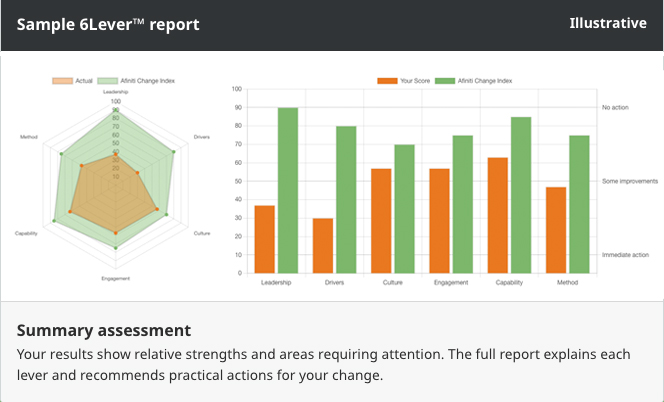
Your personalised report provides a structured, visual view of your current change environment.
- An overall readiness summary.
- A visual profile across all six levers.
- Your score for each lever.
- Comparison with the Afiniti Change Index.
- Commentary on potential strengths, gaps and areas requiring attention.
- A unique results page that you can revisit from the link sent to your email.
This practical snapshot of change readiness will help you identify strengths, potential risks and useful next actions.
Don’t rely on assumptions about readiness for change
Don’t rely on assumptions about readiness for change
Programmes often move forward on beliefs that have never been meaningfully tested:
- Leadership is aligned because nobody has openly disagreed.
- Managers are ready because they attended a briefing.
- Employees are ready because they completed training.
- Silence means acceptance rather than uncertainty, fatigue or low psychological safety.
- A sound technical design will naturally lead to adoption.
The 6LeverTM change readiness assessment tests those assumptions before they affect implementation, helping you compare perceptions and distinguish symptoms from underlying causes.

Is a readiness assessment right for your organisation?
A change readiness assessment is most valuable while there is still time to shape the programme, influence leaders and support employees, not after preventable gaps have affected delivery.
✔ You have an upcoming or in-flight transformation that depends on people changing how they work.
✔ You’re introducing new tech, processes, roles, behaviours or operating models.
✔ The expected value depends on effective adoption.
✔ You are uncertain whether leaders, managers or teams are sufficiently prepared.
✔ Several changes are competing for capacity and attention.
✔ Previous programmes have experienced resistance, low adoption or delayed benefits.
What is a change readiness assessment?
A change readiness assessment is a systematic evaluation of whether an organisation, programme or team has the conditions required to understand, adopt and sustain a planned change.
Readiness is partly subjective. A structured assessment brings consistency to that judgement by examining defined areas, gathering evidence and creating a shared language for discussing the findings.
It can be applied at organisational, team or individual level to help identify:
- Conditions likely to support adoption.
- Risks, barriers and assumptions requiring validation.
- Groups that need additional support.
- Where more leadership, engagement or resource is required.
- Whether further preparation may be needed before the programme’s next stage

A change readiness assessment should inform change strategy and action, rather than ending with a score.
Signs of change readiness include:
- People understand why the change is happening.
- Leaders champion one consistent narrative.
- Managers can explain what the change means locally.
- People can raise concerns and challenge assumptions.
- Feedback is used and visibly acted upon.
Common barriers to change readiness:
- Lack of clarity about the case for change or future state.
- Weak sponsorship and inconsistent leadership behaviour.
- Change fatigue or insufficient capacity.
- Low psychological safety and unspoken concerns.
- Unclear impacts or unequipped managers
What does the Afiniti 6Lever™ change readiness assessment measure?
Afiniti’s 6Lever™ model was developed from over two decades of change, transformation and business experience to examine six interdependent conditions that influence whether an organisation is prepared to implement and sustain change.
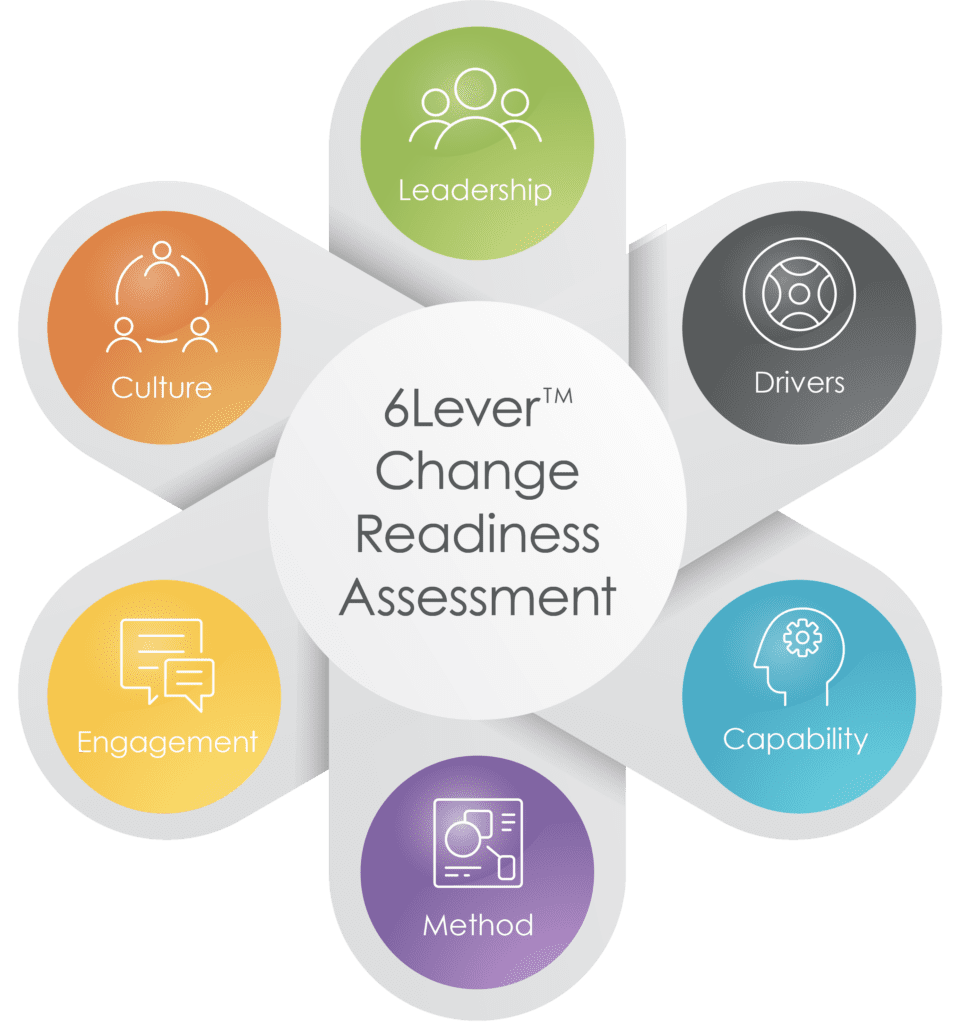
Afiniti’s 6Lever™ model was developed from over two decades of change, transformation and business experience to examine six interdependent conditions that influence whether an organisation is prepared to implement and sustain change.
Select a lever to explore what it measures, example assessment questions and practical insights.
Leadership
The commitment, alignment and capability of leaders to actively sponsor and lead the organisation through change.
What to look for
- Leaders communicate a consistent case for change and intended outcomes.
- Sponsors are visible, active and clear about their role throughout the change.
- Leaders address resistance, model the behaviours they expect from others and communicate openly about challenges as well as progress.
Example change readiness questions
- Do leaders communicate success stories as well as challenges and lessons learned in an authentic way?
- Do leaders help manage and address resistance to change in their areas?
Afiniti insight
“All change begins with leaders. They set the direction, the tone and role model behaviours, ‘walking the walk and talking the talk’.”
Read more: Showing Up as an Active and Visible Change Leader
Leadership in practice: See how Afiniti aligned 53 global leaders
Drivers
How clearly the organisation articulates the business imperative for change, the intended outcomes and the journey towards them.
What to look for
- A clear business imperative linked to strategy, benefits and the intended future state.
- People understand what is changing, why it matters and how their contribution connects to the wider outcome.
- The direction remains clear as the programme evolves, including what needs to happen, when, how and by whom.
Example change readiness questions
- Is the change strategy — the what, when, how and who — clearly articulated and understood by all?
- As a business, are you aware of resistance to change and its root causes, and do you work to overcome it to gain employees’ trust?
Afiniti insight
“The business case can be seen as a tick-box exercise that gets forgotten about once signed off.”
Read more: Why You Need a Clear Business Case for Change
Drivers in practice: See how a North Star became an actionable roadmap
Culture
Whether the organisation’s culture supports a forward-thinking, integrated and constructive approach to change and the challenges it brings.
What to look for
- Openness, adaptability and constructive challenge are reinforced through everyday behaviours.
- People feel able to speak honestly about concerns and difficulties without those views being suppressed.
- Values, recognition and leadership behaviour support change in practice, rather than simply expressing support for it in principle.
Example change readiness questions
- Is openness to change recognised and rewarded formally and informally in this organisation?
- Is the working environment an honest one, in which people at all levels are able to tell it as it is, and do so?
Afiniti insight
“Culture can reinforce desired, shared behaviours, which often get overlooked in favour of tools and processes.”
Read more: Benefits of Stakeholder Engagement and Strong Culture
Culture in practice: See how a new operating model shifted culture and mindset
Engagement
Whether people affected by the change are connected, informed, equipped, involved and committed to the change journey.
What to look for
- People have genuine opportunities to ask questions, contribute ideas and influence the change.
- Communication is two-way, varied and appropriate for different stakeholder groups.
- Formal feedback and informal sentiment indicate that people feel connected to the change, rather than simply informed about it.
Example change readiness questions
- Are informal conversations across colleagues positive, reflecting the overall mood of the company?
- Are communication methods varied and measurably effective?
Afiniti insight
“Engagement must be multi-dimensional: Storytelling, role modelling and listening each play a distinct role and are most powerful when combined.”
Read more: Keeping Your Workforce Engaged in the New Age of AI-Driven Change
Engagement in practice: See how co-creation accelerated stakeholder alignment
Capability
Whether the organisation has and develops the people, competencies, capacity and resources needed to support the change and operate effectively in the future state.
What to look for
- The skills, competencies, capacity and resources needed for the future state have been identified.
- People affected by the change have appropriate support to build the capability they will need.
- Sufficient business change capability exists to support delivery and sustain adoption, rather than relying solely on individual projects or external support.
Example change readiness questions
- Has the organisation identified the capabilities and skills required to sustain the change, e.g. digital, data, business process?
- Is there business change capability available to support projects/initiatives either from central resources or as a normal part of functional capabilities?
Afiniti insight
“We don’t change the organisation; we help the organisation’s people to drive the change.”
Read more: Learn to Fish: How to Build Change Capability
Capability in practice: See how Afiniti built sustainable internal change capability
Method
Whether the organisation has defined, communicated and consistently applies effective ways of shaping and delivering change.
What to look for
- A clear and proportionate approach exists for shaping, governing and delivering the change.
- Benefits, impacts, risks and actions have clear ownership and are reviewed as the change progresses.
- Teams learn from experience and adapt the approach where evidence shows something is not working.
Example change readiness questions
- Are benefits and impacts (dis-benefits) identified, profiled, regularly measured and analysed and have clear ownership as part of any change activity?
- Are lessons learned used to inform future change programmes?
Afiniti insight
“Start with your context, not the model. Diagnose before you prescribe.”
Read more: Change Models Explained: How to Choose, Blend and Apply Them
Method in practice: See how a global change methodology created consistency
CHANGE READINESS CASE STUDY
1,000
impacted people
10+
global exec leaders aligned
70%
engagement rate
Building change readiness during major transformation
A global energy consultancy with more than 1,000 people was entering substantial transformation. Structural change, commercial pressure and leadership turnover had created fragmentation, change fatigue and uncertainty.
Afiniti’s contribution
- Conducted 12 in-depth leadership interviews and facilitated senior discussions.
- Structured the findings around the six change levers.
- Translated insight into a practical business-change plan and clear leadership roles.
- Adapted the work to support an unexpected CEO transition.
The engagement surfaced risks previously based largely on assumption, maintained momentum through the leadership transition and informed the incoming CEO’s roadmap.
“The Afiniti team are very easy to engage with, and they give confidence in their expertise as business change specialists.” CEO
When should you assess readiness?
When should you assess readiness?
Before launch, during delivery or when you need to course-correct.
Readiness changes as programmes evolve. Assessing at the right moments can reveal where leadership, capability, engagement or organisational capacity needs attention before those gaps affect adoption.
- While shaping the strategy and case for change.
- Before programme mobilisation or a major design decision.
- Ahead of rollout or go-live.
- When adoption, trust or engagement is deteriorating.
- After a major change in leadership, scope or direction.
- At the start of a new release, wave or phase.
- When several programmes compete for capacity.
- After corrective action, to review progress.
Treat the assessment as a decision and planning tool, not a one-off compliance exercise.


How to run a change readiness assessment
A credible assessment begins by defining the change, involving the right perspectives and using the score as a starting point for investigation and action.
the change being assessed
Establish the change type, strategic purpose, intended outcomes, affected functions, number and types of people impacted, magnitude, programme stage and the decision the assessment needs to inform.
Consider impacts to processes, systems, tools, roles, skills, behaviours, operating model, governance, KPIs, data and customer or supplier interactions.
the right perspectives
Gather input from leaders and sponsors, managers, affected employees, change practitioners, HR and programme teams. External facilitation is especially useful when neutrality, constructive challenge or cross-functional participation matters.
The assessment should be specific enough that respondents are considering the same change rather than general sentiment.
multiple types of evidence
Interpret readiness scores alongside change impact assessments, interviews, surveys, focus groups, training needs assessments, capacity data, risk assessments, engagement data, adoption measures and lessons from comparable change.
Look for patterns, disagreement between groups and vulnerable communities, not just an overall average.
findings and reassess
Use findings to determine leadership, communication, engagement, manager, learning, capacity, governance and risk actions. Give every material action an owner, date, measure and review point.
Repeat the assessment at a meaningful phase, rollout wave or decision point to understand whether conditions are improving and if new risks have emerged.
How to understand your result
Read the profile, not just the overall score
Your result is directional rather than a pass-or-fail judgement.
- Leadership: sponsorship and visibility.
- Drivers: purpose, benefits and future vision.
- Capability: time, resources, skills and support.
- Method: governance, decisions, risks and delivery.
- Engagement: involvement, feedback and local ownership.
- Culture: trust, fatigue and established behaviours.
Focus on the pattern, not just the overall score. Differences between the six levers can reveal where attention is most needed. For complex or organisation-wide change, comparing perspectives from different stakeholder groups can provide a richer picture of readiness.
How the Afiniti Change Index is used
Your results are compared with the Afiniti Change Index, a change readiness reference developed through more than 20 years of Afiniti’s experience supporting organisational change.
The Index weights the six levers differently, reflecting our practitioners’ experience that some conditions require greater emphasis when preparing an organisation for change.
Comparing your results with the Index helps highlight:
- Areas of relative strength.
- Levers that may need greater attention.
- Priorities for further investigation and discussion.
- Where targeted action could strengthen readiness.
Free change readiness assessment template
Free change readiness assessment template
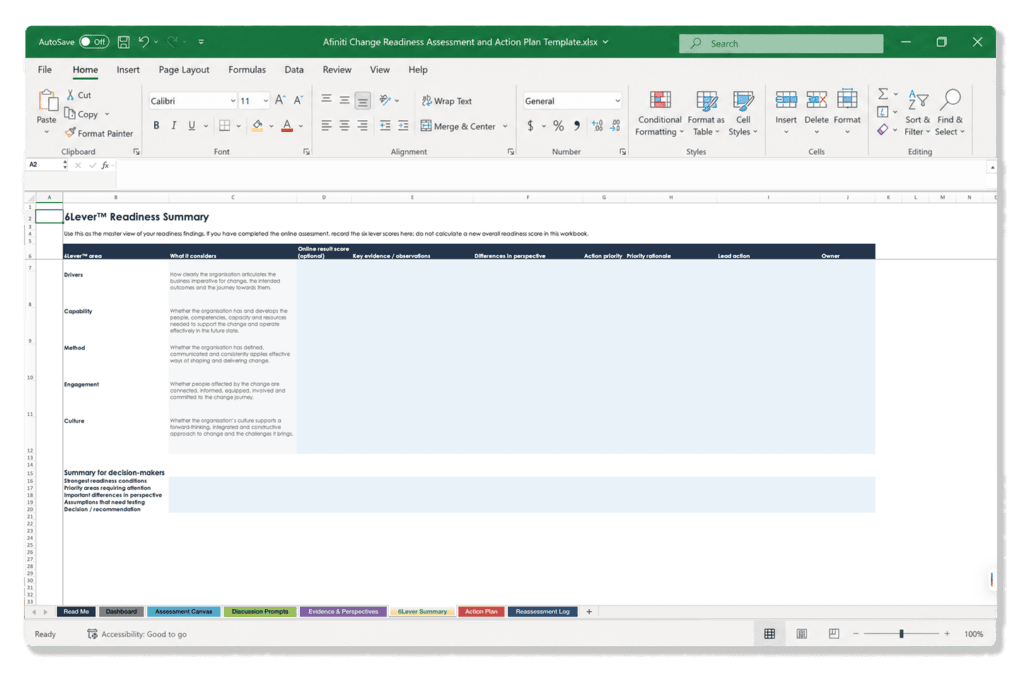
Use this change readiness assessment template to plan your assessment, capture supporting evidence and different perspectives, prioritise readiness issues and assign clear actions.
The workbook is designed to work alongside Afiniti’s 6Lever™ online assessment. Use 6Lever™ for your scored readiness diagnostic and comparison with the Afiniti Change Index, then use the template to explore what sits behind the results and:
- Structure stakeholder input
- Capture evidence across the six levers
- Turn findings into owned actions and reassessment
This is an editable Excel workbook. There’s no separate scoring model to learn; the template complements your 6Lever™ results rather than recreating the assessment.
Common readiness mistakes
- Treating readiness as a checklist
- Assuming leadership alignment
- Failing to equip managers
- Mistaking training attendance for readiness
- Inviting feedback without acting on it
- Relying on previous success
Completing an assessment does not make the organisation ready. The value lies in understanding and acting on the result.
Why Afiniti?
Afiniti has more than 20 years’ experience helping organisations shape, deliver and sustain complex business change. That experience informs 6Lever™, our structured approach to assessing Leadership, Drivers, Capability, Method, Engagement and Culture.
We look across people, processes, systems and data to identify where change may need greater attention. For complex transformations, our practitioners can go beyond the online assessment, combining representative input with facilitated discussion to understand what sits behind the scores and turn the findings into practical priorities.







Meet our change readiness practitioners
Change readiness assessment FAQs
A change readiness assessment is a structured way to understand how prepared an organisation, team, programme or project is for change. It helps identify strengths, potential barriers and areas that may need greater attention before or during delivery. Afiniti’s 6Lever™ assessment considers readiness across six areas: Leadership, Drivers, Capability, Method, Engagement and Culture.
Afiniti’s 6Lever™ assessment looks at six conditions that influence readiness for change: Leadership, Drivers, Capability, Method, Engagement and Culture. These consider areas such as leadership commitment, clarity of purpose, available skills and resources, how change is managed, how people are engaged and whether the organisational culture supports change.
The online assessment is most useful for someone with a good understanding of the change and the environment in which it is taking place, such as a sponsor, programme or project lead, change practitioner or senior stakeholder. For a broader organisational view, Afiniti can involve relevant leaders and representatives from different functions or stakeholder groups, using facilitated discussion to explore the reasons behind different perspectives.
Assessing readiness early gives you more opportunity to address gaps before they become barriers to delivery. Afiniti recommends considering readiness as part of the initial strategy for change, but it can also be valuable during delivery, before major implementation stages or when circumstances change. For longer or more complex programmes, repeating the assessment at key points can help show where priorities have shifted.
A change readiness assessment looks at how prepared the organisation and its people are to adopt and sustain change. A change impact assessment looks at what the change will affect, for example roles, processes, systems, skills and ways of working. Used together, they help you understand both what is changing and how ready the organisation is to respond.
The online 6Lever™ assessment takes around five minutes to complete. You receive a personalised report showing your results across the six levers, areas that may need greater attention and practical recommended actions. Your results are also compared with the Afiniti Change Index to help you understand the relative pattern of readiness across the six areas. One of our expert change consultants would be happy to have a no-obligation discussion with you to explore your results further.
-
Find out where your change needs attention
Get a practical view across all six readiness levers
Complete the five-minute assessment to identify relative strengths, potential gaps and next actions.
-
Related Posts
Step 1 - About Your Change
- About Your Change (current step)
- Readiness Questions 1
- Readiness Questions 2
- Readiness Questions 3
- Get Your Report
Step 2 - Readiness Questions 1
- About Your Change (completed)
- Readiness Questions 1 (current step)
- Readiness Questions 2
- Readiness Questions 3
- Get Your Report
Please consider the below statements. Score each appropriately depending on how much you agree or disagree, where a score of 10 would mean you totally agree, a score of 1 would mean you totally disagree.
Please complete each question. Try not to reflect too long on the statements; typically your first reaction is the correct score.
Disagree
Agree
Step 3 - Readiness Questions 2
- About Your Change (completed)
- Readiness Questions 1 (completed)
- Readiness Questions 2 (current step)
- Readiness Questions 3
- Get Your Report
Please consider the below statements. Score each appropriately depending on how much you agree or disagree, where a score of 10 would mean you totally agree, a score of 1 would mean you totally disagree.
Please complete each question. Try not to reflect too long on the statements; typically your first reaction is the correct score.
Disagree
Agree
Step 4 - Readiness Questions 3
- About Your Change (completed)
- Readiness Questions 1 (completed)
- Readiness Questions 2 (completed)
- Readiness Questions 3 (current step)
- Get Your Report
Please consider the below statements. Score each appropriately depending on how much you agree or disagree, where a score of 10 would mean you totally agree, a score of 1 would mean you totally disagree.
Please complete each question. Try not to reflect too long on the statements; typically your first reaction is the correct score.
Disagree
Agree
Step 5 - Get Your Report
- About Your Change (completed)
- Readiness Questions 1 (completed)
- Readiness Questions 2 (completed)
- Readiness Questions 3 (completed)
- Get Your Report (current step)
Get your personalised 6Lever™ report
Enter your details to view your results and receive a link to your personalised report by email.