


Change Management ROI: How to Calculate, Measure and Prove Value
Every major transformation carries a business case that projects savings, productivity gains or revenue uplift to secure investment. What it rarely accounts for is whether the people affected will actually change how they work. Only 32% of business leaders said the last change they led achieved healthy change adoption by employees. That gap, between projected benefit and realised value, is where change management ROI is won or lost.
This article is a practical guide for executives evaluating where change management creates genuine value, how to measure it and how to sustain it once the programme ends.
What Change Management ROI Really Means
Change management ROI is the net value realised from a transformation initiative relative to the cost of delivering it. The difficulty is not the arithmetic; it is the accuracy of what sits on each side of the equation.
Most organisations calculate projected ROI before a programme begins. Fewer measure realised ROI during or after it ends. The distinction matters because unlocking business benefits depends on people changing their behaviour, their processes or their systems, which happens after the programme ends.
There are two categories of benefits worth separating. Direct financial benefits are those that materialise regardless of employee behaviour, such as vendor contract savings, licence consolidation or headcount reduction through restructuring. Adoption-dependent benefits are those that require people to work differently, such as productivity gains from a new platform, revenue growth through a changed sales process or cost avoidance from improved compliance. In most transformations, adoption-dependent benefits account for the greater share of value.
Change management ROI, properly defined, is the value released when people adopt the change at the rate and speed the business case assumed.
The Real Driver of ROI: Adoption, Behaviour and Usage
Measuring ROI on change management requires acknowledging an uncomfortable reality: the financial projections in a business case are built on assumptions about human behaviour. If those assumptions are wrong, the return will also be wrong.
Adoption is not a binary outcome. It moves along a curve from initial awareness and intent through to consistent, skilled usage that becomes embedded in daily work. The position of the organisation on that curve at any given point directly determines how much of the projected value has been unlocked. A 60% adoption rate six months after go-live is not a partial success; it is a signal that 40% of the expected return is still at risk.
The drivers of adoption speed and depth include:
- Visible, consistent sponsorship from senior leaders whose credibility employees trust
- Direct manager engagement, since managers remain the primary influence on whether teams sustain changed behaviour
- Communication that explains not just what is changing but why it matters and what employees are expected to do differently
- Training and support that is practical, timely and relevant to the specific role
- Reinforcement mechanisms, including performance conversations, recognition and system design that makes the new way easier than the old
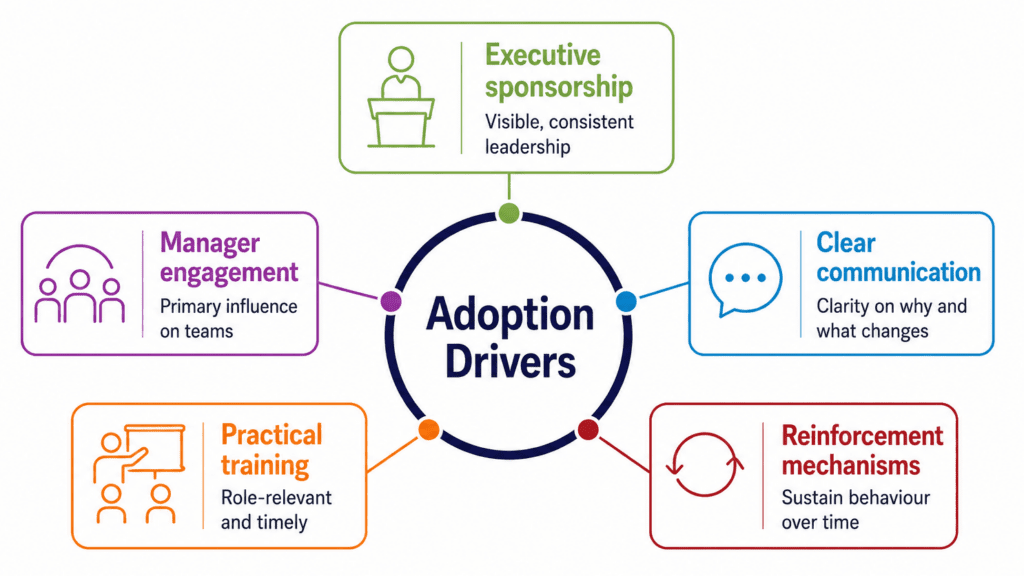
Leadership visibility and manager capability in supporting their teams through change are among the highest-leverage inputs available to any programme.
The Cost of Poor Change Management, and Why ROI Falls Short
When transformation programmes underdeliver, the diagnosis is often that the change was not embedded. Poor change management can have direct financial consequences:
- Project delays caused by resistance or rework increase programme costs and delay the point at which benefits begin to accrue
- Productivity dips that extend beyond the expected transition period erode the net return
- Compliance failures or inconsistent process adoption create risk and remediation costs
- Customer impact during a poorly managed transition generates attrition and reputational damage
- Staff turnover driven by change fatigue or perceived mismanagement increases recruitment and onboarding costs
Resistance and disengagement are measurable delays in value realisation. On a large ERP implementation, even one month of slower-than-expected adoption can represent millions in unrealised productivity.
The root causes are consistent across organisations and sectors. Sponsorship is either absent or performative, with senior leaders endorsing the programme without actively role-modelling the change. Organisations fail to establish baselines before rollout, making it impossible to measure what has improved. Adoption is tracked by training completion rather than actual usage or behaviour change. And the change programme often winds down before the organisation has genuinely embedded the new ways of working.
Change management ROI falls short when the investment in capability, communication and reinforcement is treated as an optional overhead rather than a prerequisite for value realisation. Organisations that underfund the people side of transformation consistently report lower returns from their technology and operational investments than those that treat behaviour change as a first-order deliverable. Projects with excellent change management are up to 7x more likely to achieve objectives.
Looking to maximise change management ROI?
One of the most effective ways to maximise ROI is to bring in change experts who have done it before: people who know how to accelerate adoption, reduce drag on delivery and keep the focus on outcomes. Get in touch with our team to discuss how we can help maximise your ROI.
How to Calculate Change Management ROI
A credible approach to calculating change management ROI follows four steps. It requires honest assumptions, early baseline measurement and a clear line of sight between adoption behaviour and financial outcomes.

Step 1: Identify the adoption-dependent benefits
Start with the business case and isolate the benefits that require people to work differently. These are the benefits at risk if adoption is weak. Common examples include productivity improvements from a new system, revenue uplift from a changed commercial process, reduced error rates from a redesigned workflow and cost avoidance from improved compliance.
Step 2: Quantify those benefits with adoption assumptions made explicit
For each adoption-dependent benefit, model what the return looks like at different adoption rates and speeds. A productivity gain projected on 100% adoption at three months post-launch looks very different at 65% adoption at six months. State the assumptions clearly to help make informed investment decisions.
Step 3: Calculate total programme costs
Include the direct costs of the change management programme: advisory or consultancy fees, internal resource time, communications and training development, tools and technology and any external facilitation. Include an honest estimate of leadership time, since senior sponsor time has a real opportunity cost even when it does not appear on a budget line.
Step 4: Apply the ROI formula and revisit it
ROI (%) = ((Benefits Realised – Benefits Costs) / Programme Costs) × 100
Run this calculation at project close and again at six and twelve months post-implementation, using actual adoption data rather than projections. The gap between the two is the most useful number in the analysis: it shows what was recovered and what is still outstanding.
Worked Example
An organisation implements a new CRM platform with a projected annual productivity benefit of £2.4 million, assuming 80% adoption at month four. The change management programme costs £180,000. At month six, adoption is at 70% and is still climbing. Realised benefit at that point is approximately £1.4 million annualised. ROI at month six is approximately 678%, with further upside as adoption improves. The calculation also makes clear that each percentage point of adoption is worth approximately £30,000 per year in productivity value, which frames the investment in continued reinforcement in terms a CFO can work with.

Which Metrics Matter Most? Track Financial, Adoption and Risk Indicators
Organisations that measure ROI on change management effectively often use metrics across three categories. The strongest programmes treat these as a connected dashboard rather than a list of isolated indicators.
Financial Metrics
Measure the outcomes that the transformation was designed to deliver. These include cost savings against projection, revenue growth attributable to changed processes, productivity improvement measured in output per head or time-to-completion and downtime or error reduction. They require pre-implementation baselines to be meaningful.
Adoption Metrics
The measure of human behaviours that drive financial outcomes. These include system usage rates by role and team, process compliance and adherence, training completion and competency assessment results, manager reinforcement behaviours and the speed at which individuals and teams move from initial use to proficient independent use. Adoption metrics are leading indicators of financial performance; they tell you whether the return is on track before it shows up in the numbers.
Risk and Stakeholder Metrics
Assess the conditions that determine whether adoption will sustain. These include employee engagement and confidence scores at key milestones, resistance indicators such as escalations, complaints or workaround adoption, sponsor activity levels and customer satisfaction where the change has an external impact. Declining stakeholder confidence is an early warning signal that adoption, and therefore ROI, is at risk.
The single most common measurement failure is relying on training completion as a proxy for adoption. Attendance at a training session is an input. Changed behaviour in the workplace is the output. Measuring the former while managing the latter is a structural weakness in how many organisations approach organisational metrics for change management ROI.
How Leaders Should Evaluate the Change Management Investment
The investment decision is not simply whether to fund change management. It is how much to invest, where to direct that investment and who owns the outcomes. These are governance questions as much as they are budget questions. A practical framework for evaluating the investment begins with three questions:

Which projected benefits depend on people adopting the change?
If the answer is most of them, the case for substantive investment in the people side of the programme is self-evident.
What would it cost if adoption fails or stalls?
Model the downside first. If a six-month adoption delay on a programme projecting £5 million in annual savings costs £2.5 million in unrealised benefit, against a £250,000 change management investment, the decision makes itself.
Who is accountable for adoption outcomes?
This is where many organisations stumble. The project team is accountable for delivery. The technology team is accountable for the system. Accountability for whether people actually change how they work tends to be assumed rather than assigned explicitly. Effective programmes make adoption a named deliverable with a named owner, typically the business sponsor rather than the HR or change team.
Clarity on ownership matters for ROI measurement as well as delivery. If no one is accountable for sustaining adoption after go-live, the investment in the programme will not be protected by the reinforcement the organisation needs to realise the full return.
A useful governance structure for assessing change management investment includes: an executive sponsor who is accountable for adoption and business outcomes; a programme lead who tracks adoption metrics and escalates risk; a network of line managers who are equipped and supported to reinforce changed behaviours; and a change team that measures, adjusts and reports throughout the delivery lifecycle and beyond.
How to Measure, Improve and Sustain ROI Over Time
Change management ROI is an ongoing management discipline. Organisations that treat it as a one-off calculation at programme close consistently leave value on the table. The discipline of sustained ROI measurement requires four practices.
Establish Baselines Before Rollout
Measure the current state of the metrics the change is intended to improve before the programme launches. Without a baseline, post-implementation data has no reference point and the return cannot be reliably attributed.
Review Adoption and Business Outcomes
The milestone structure will depend on the scale and type of change, but reviews at one, three, six and twelve months post-implementation are a reasonable starting framework. Each review should assess adoption progress against the model, financial performance against projection and the conditions, sponsorship, manager engagement, reinforcement, that are supporting or limiting adoption.
Reinforce Actively and Adjust Where Needed
Adoption that plateaus before it reaches the target level is a signal that reinforcement is insufficient, that barriers have not been removed or that the initial design of training or communication did not address the actual obstacles people face. Effective programmes treat post-go-live reinforcement as a core activity, not an afterthought.
Report Progress Transparently
The ROI story is most useful when it is told honestly, including where realised value is behind projection and what is being done about it. Transparent reporting builds the organisational credibility of change management as a discipline and makes it easier to secure investment in future programmes.
Transformation only delivers value when people adopt and sustain new ways of working. Measuring change management ROI is not about justifying the investment in change; it is about protecting the value the organisation set out to achieve in the first place. The organisations that realise the strongest returns are those that treat adoption, reinforcement and leadership accountability as core business priorities, not optional programme support.
Measure your readiness for change
Try our free Change Readiness Assessment to understand how prepared your organisation is for transformation and where action is needed to improve adoption, reduce risk and protect ROI.
Change Management ROI FAQs
Calculate change management ROI by identifying the benefits that depend on adoption, quantifying them with explicit assumptions about adoption rate and speed, then comparing realised benefits against total programme costs using the formula: ((Benefits Realised − Programme Costs) / Programme Costs) × 100. Measure at programme close and at six and twelve months post-implementation using actual adoption data.
The most important metrics are adoption rate by role and team, speed-to-proficiency, financial outcomes against the pre-implementation baseline, and stakeholder confidence and engagement scores. Training completion is a weak proxy for adoption; actual usage and behaviour change in the workflow are stronger indicators.
Proving ROI is hardest when organisations skip pre-rollout baselines, track adoption by activity rather than behaviour change, and stop measuring before performance stabilises. Attribution compounds the challenge: financial outcomes in complex organisations rarely trace to a single initiative. The solution is not to avoid measurement but to be clear about what is being attributed, on what basis and with what confidence.
The most consistent causes are weak or performative executive sponsorship, insufficient manager capability, and a failure to sustain reinforcement after go-live.
Poorly managed change produces extended productivity dips, partial adoption and workaround proliferation and in many cases, costly reversion to previous ways of working. Direct costs (rework, remediation, extended timelines) are measurable; indirect costs (staff disengagement, customer impact, loss of execution confidence) are harder to quantify but equally real