



Agile Change Management: Driving Adoption in Agile and Scrum Projects
In a previous blog we explored what it really means to work with an agile mindset: being adaptable, responsive, and ready to pivot when opportunities or risks emerge. In this article, we focus specifically on Agile change management and why it is critical to the success of agile and Scrum projects, particularly for end users adopting new systems and business processes.
Agile delivery is great news for organisations. By working iteratively, value can be realised earlier and more frequently. However, this pace and flexibility mean that change management in agile projects must evolve beyond traditional, linear approaches. When the “to-be” solution is still emerging sprint by sprint, change management cannot be bolted on at the end; it must be embedded throughout delivery.
Why Agile Change Management Matters
A typical Scrum setup includes a Scrum Master facilitating delivery and a Product Owner representing business priorities and user needs. This structure defines the what and the who. But one critical question is often left unanswered: how will people actually adopt the change?
Without effective scrum change management, teams risk delivering technically sound solutions that fail to gain traction. Agile change management ensures users are prepared, engaged, and confident,so benefits are realised as quickly as the software itself is delivered.
Below are our five proven tips for integrating change management into agile and Scrum projects to accelerate adoption and maximise value.
1. Build the Agile Change Triangle: Product Owner, Scrum Master, Change Manager
One common myth is that agile delivery automatically guarantees user adoption. In reality, change management in Scrum is what turns frequent releases into real business outcomes.
The most successful agile programmes bring the Change Manager into the core delivery team alongside the Product Owner and Scrum Master. This “project triangle” ensures that the voice of the user is heard at every stage, not just during requirements gathering.
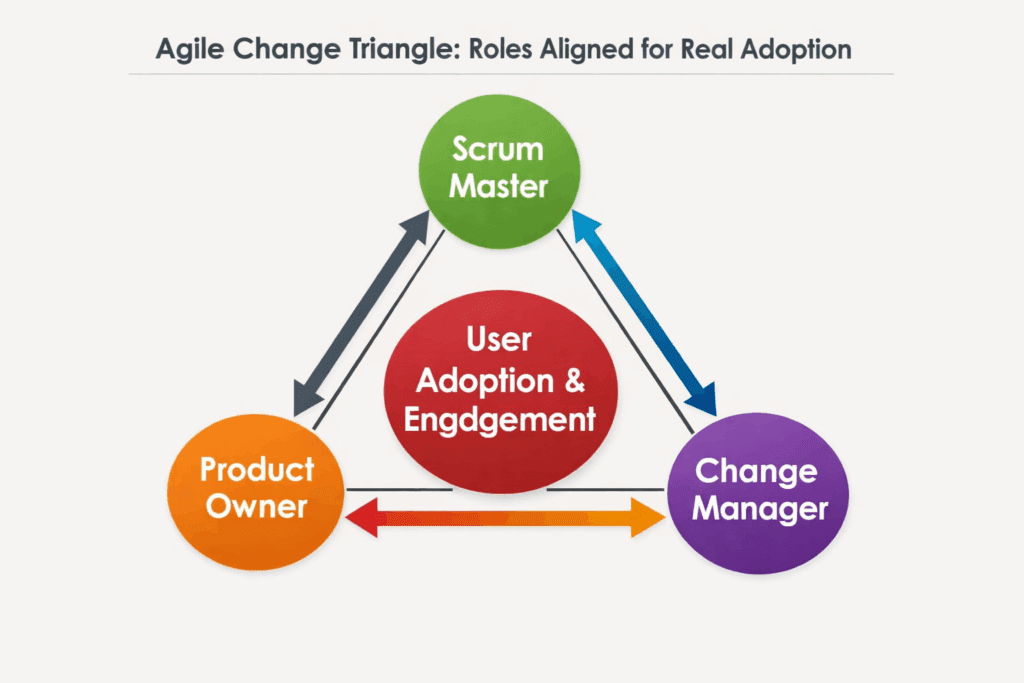
By working closely with the Product Owner, the Change Manager translates evolving priorities into clear, meaningful messages for the business. By partnering with the Scrum Master, they stay aligned with sprint planning, re-prioritisation, and delivery timelines, keeping stakeholders informed and engaged even as plans change.
Embedding change management at sprint level allows teams to:
- Track engagement and adoption incrementally
- Identify and address resistance early
- Continuously refine communication and training based on feedback
2. Front-Load Engagement in Agile Projects
User adoption in agile environments starts with early and proactive engagement. Stakeholders and end users need to understand not just what is changing, but how agile delivery works.
Without upfront engagement, users accustomed to waterfall delivery may struggle with:
- The pace of iterative releases
- Evolving requirements
- Uncertainty around the final solution
Effective agile change management sets expectations early by explaining:
- How decisions are made in Scrum
- What input is expected from users
- How and when benefits will be realised
A blended engagement approach works best, combining senior leader sponsorship, super-user workshops, and clear, concise communications. Just as importantly, feedback loops should be established early, testing assumptions and increasing engagement where needed.
3. Design Change Management to Be Flexible
Agile delivery means constant evolution, and your change management approach must be just as adaptable. Traditional, fixed change plans rarely survive first contact with an agile backlog.
Successful change management in agile projects relies on:
- Regularly revisiting engagement and communication plans
- Prioritising messages based on sprint outcomes
- Strong collaboration between the Product Owner, Scrum Master, and Change Manager
When delivery priorities shift, change managers must be ready to pivot messaging and engagement tactics quickly. This flexibility ensures that communications remain accurate, timely, and credible, protecting trust and adoption even when direction changes.
Agile change management works best when governance, roles, and decision-making are clearly defined, enabling teams to explain what is changing, why it matters and what happens next.
4. Establish a Strong Communications Rhythm and Change Champions
Agile and Scrum projects create a continuous flow of enhancements rather than a single “big bang” release. This requires a responsive communications model that can scale with delivery.
An effective scrum change management approach includes:
- A clear communication cadence aligned to sprint reviews and releases
- Pre-agreed reviewers and approvers for fast turnaround
- A strong network of influential change champions
In agile environments, champions play an even more critical role than in traditional projects – more than 80% of studies found champions helped. They must be comfortable with ambiguity, able to explain evolving priorities, and influential enough to challenge delivery teams when user value is at risk.
Champions act as a two-way conduit: translating change for their teams while feeding real-time insights back into the project. Investing time in stakeholder mapping helps identify champions with the right credibility and reach.
5. Transfer Ownership to the Business Early
Ultimately, adoption depends on ownership. Agile change management succeeds when the business feels accountable for the solution, not just the project team.
This ownership starts during requirements definition and continues through design, development, and validation. Agile provides a powerful opportunity to involve users through:
- Early visibility of designs and prototypes
- Sprint reviews and “show and tell” sessions
- Incremental business validation
While deep business engagement can feel like a distraction from delivery, it consistently reduces risk, prevents late-stage surprises, and builds trust in the solution.
Formalising regular demonstrations and validation sessions allows users to become familiar with the solution over time, checking data, understanding functionality, and building confidence well before go-live.
Agile Change Management: A Prerequisite for Adoption
Agile and Scrum delivery methods accelerate development, but agile change management accelerates adoption. By integrating change management into Scrum roles, planning cycles, and communications, organisations ensure that speed does not come at the expense of engagement.
When users trust the journey, understand the value, and feel ownership of the outcome, adoption follows naturally, unlocking the full benefits of agile delivery.
Get help with Agile
At Afiniti, we regularly work with clients, building their change management capability and integrating with their Agile projects. If this is a topic you’ve been thinking about recently and you’d like some advice on how to set your Agile change management projects up for success, get in touch and we would be happy to discuss this further.
Agile Change Management FAQs
Agile change management is the practice of preparing, supporting, and enabling people to adopt change within agile delivery environments. Unlike traditional change management, it is iterative, flexible, and aligned to sprint cycles, supporting frequent releases, evolving requirements, and continuous feedback.
Change management in agile projects ensures that rapid delivery translates into real business value. Without it, teams may deliver working software that users do not adopt. Agile change management builds engagement, reduces resistance, and helps users understand and embrace change incrementally.
Scrum change management works by embedding change activities into the Scrum cadence. Change Managers collaborate with the Product Owner and Scrum Master to align communications, training, and engagement with sprint planning, reviews, and releases, ensuring users are ready for each increment.
In agile and Scrum teams, the Change Manager focuses on user adoption and business readiness. They shape engagement strategies, manage stakeholder expectations, support sprint-level validation, and adapt change tactics as priorities evolve, working alongside the Product Owner and Scrum Master.
Agile change management is continuous and adaptive, while traditional change management is often linear and plan-driven. In agile environments, change activities evolve with the solution, respond to feedback, and are delivered incrementally rather than through a single end-of-project rollout.
Change management should start at the very beginning of an agile project. Early engagement helps stakeholders understand how agile delivery works, sets expectations around evolving scope, and builds trust before the first sprint release, reducing resistance later.
Stakeholder engagement in agile change management is managed through frequent communication, early involvement, and continuous feedback. Techniques include sprint reviews, show-and-tell sessions, change champions, and targeted communications aligned to delivery milestones
Change champions in agile projects are influential stakeholders who support adoption at a local level. They help explain changes, gather feedback, and reinforce key messages, acting as a bridge between delivery teams and the wider business throughout the Scrum lifecycle.
Agile change management supports faster value realisation by enabling users to adopt new capabilities as they are released. By preparing users incrementally, validating changes early, and addressing resistance quickly, benefits are realised sooner rather than waiting until final delivery.
While agile projects can deliver working software without formal change management, they often struggle with adoption. Scrum change management increases the likelihood that solutions are understood, accepted, and used, maximising return on investment and reducing rework.
To get the latest change tips, advice and guidance directly to your inbox, sign up to our monthly Business Change Digest.
Related Insights

- Dowgate Hill House,
14-16 Dowgate Hill,
London, EC4R 2SU - enquiries@afiniti.co.uk