

Stakeholder Mapping Tools: Identify and Engage the People at the Heart of Your Change
No change happens in isolation. Your colleagues, users, leaders, clients, regulators, suppliers and partners can all shape the direction and outcome of your initiative. When their interests and needs aren’t understood and addressed, your change faces delays, diminished results or complete failure.
A stakeholder map visualises the people landscape in which you’re delivering your change. It’s not about creating documents for compliance; it’s about understanding who holds the keys to your success and engaging them accordingly.
What Is Stakeholder Mapping?
Stakeholder mapping is a systematic approach to identifying and analysing everyone who influences or is affected by your change initiative. It lists all project stakeholders based on their interest and influence, creating a visual framework that informs decisions about engagement timing, intensity and approach.
Stakeholders are the people, teams or functions impacted by or having an impact on your change project. They range from end users and middle managers to executive sponsors, external partners and regulatory bodies. The scale varies dramatically: a minor process adjustment might involve a dozen stakeholders, whilst enterprise-wide transformation touches thousands.
A stakeholder map answers fundamental questions:
- Who needs to care about this change?
- Who can accelerate or derail it?
- Who must be brought along for implementation to succeed?
These aren’t abstract considerations; they determine whether your change delivers value or becomes another failed initiative.
Why Stakeholder Mapping Matters
Engaging the right stakeholder at the right time in the right way can make or break your change, ensuring it’s received positively and adopted successfully – in fact, 78% of projects with high stakeholder engagement succeed, compared with only 40% success for low-engagement projects. Creating and updating a stakeholder map reveals who stakeholders are, what their role is in the change, how they influence others impacted by or involved in your initiative, how involved they should be and the level of engagement they need.
This information directly informs your stakeholder engagement plan and priorities. It highlights groups that might need more attention, resource or pose greater risk to your change.
Consider a technology upgrade that improves customer service. Front-line staff have high interest because it changes their daily work. Senior leaders have high influence because they control budgets and signal organisational priorities. Regional managers sit in both camps. Without mapping these dynamics, you might invest heavily in executive briefings whilst neglecting the team leads who actually drive adoption. The system goes live, staff resist, customers notice and leaders question the investment.
The map prevents this. It ensures proportionate engagement across all groups who matter, not just those who are most visible.
When to Create Your Stakeholder Map
Map stakeholders at the start of the project once objectives are decided. Getting upfront audience data helps inform engagement and communications before you’ve committed to specific approaches or timelines.
The stakeholder map should be reviewed regularly to ensure it remains accurate. People change roles, new partners join, business priorities shift. A map created in January might be substantially wrong by June if you’re not maintaining it.
Stakeholder mapping should be done in collaboration with other members of the change team to ensure it’s comprehensive, objective and that all are aligned and agreed on the outputs. Individual perspectives carry blind spots. Your project manager might overlook regulatory stakeholders. Your technical lead might underestimate operational users. Collaboration surfaces these gaps.
The Stakeholder Mapping Process
Step 1: Define What ‘Stakeholder’ Means for Your Change
Anyone who may be involved in or impacted by your change can be considered a stakeholder, including external partners or customers. The scale of your stakeholder map depends on the scale of your change.
A minor process change impacting a small team will have a small stakeholder map. A major digital transformation at enterprise level impacts all colleagues, customers and suppliers, requiring much more detailed stakeholder analysis.
Before you start listing names, establish boundaries. For a departmental workflow change, stakeholders might be limited to that department plus IT support and the process owner’s manager. For a customer-facing platform replacement, you’re looking at multiple internal departments, customers, technology vendors, compliance teams and potentially regulators.
This definition prevents scope creep in your mapping exercise whilst ensuring you don’t miss critical voices.
Step 2: Define How You’ll Group Your Stakeholders
You’ll need to define how you’ll group your stakeholders so you can tailor engagement to them accordingly. Grouping stakeholders makes it easier to list them systematically so none are missed and to target them with communications.
Groupings might include role, function, capability, geography, customer segment or supplier category. The right grouping depends on your change. If you’re implementing new compliance requirements, grouping by function makes sense because legal, finance and operations face different implications. If you’re rolling out regional systems, geography matters more because implementation phases vary by location.
These groupings become the structure for your engagement plan. Instead of managing hundreds of individual relationships, you design approaches for coherent segments with shared characteristics.
Step 3: List and Begin Mapping Your Stakeholders
Once you’ve defined stakeholders and how to group them, you can start to list them. Your stakeholder map should be a living document, not one and done, so you can add new stakeholders if they are missed or emerge later.
Start broad and refine. Brainstorm every person, team or organisation that touches your change. Don’t self-edit initially; you can consolidate later. Use your groupings to prompt memory: have we considered all affected functions? All customer types? All vendor relationships?
Once listed, you can map them according to their influence and interest.
How to Map Stakeholders: The Power-Interest Matrix
The stakeholder map shows how much engagement each stakeholder needs based on their level of influence or power on the change and their interest in it.
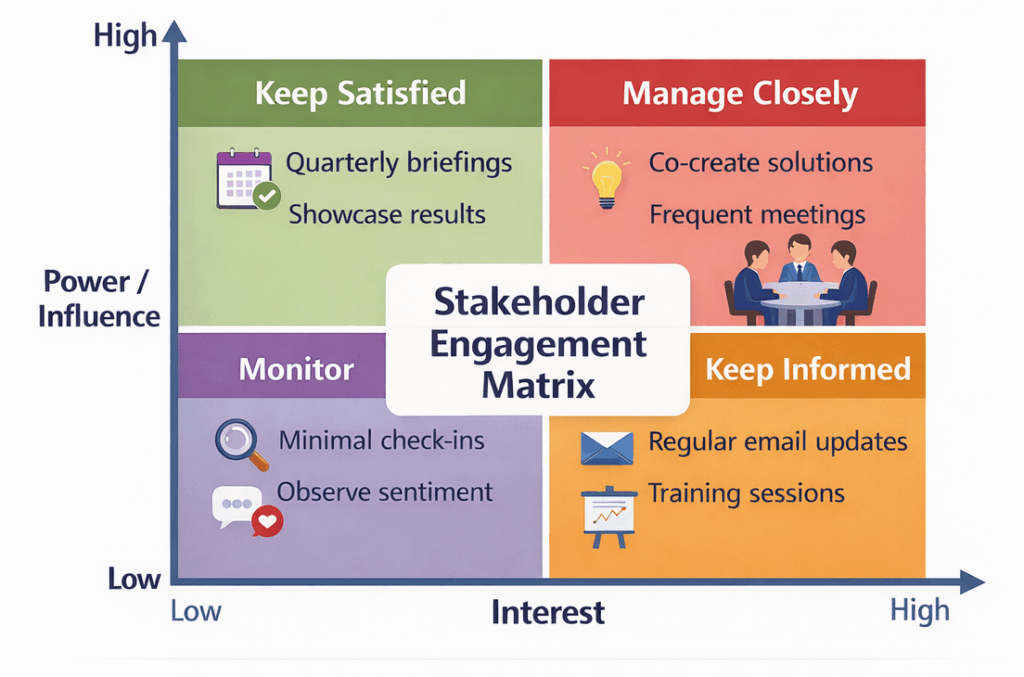
A stakeholder engagement matrix is a common way of visualising your stakeholders. The Mendelow power-interest matrix, developed by researcher Aubrey L. Mendelow, is a widely used format. Each stakeholder is mapped on a four-quadrant graph with ‘influence or power’ on the Y axis and ‘interest’ on the X axis. High values sit at the top and right; low values at the bottom and left.
The four quadrants represent distinct engagement strategies:
Top left: Keep Satisfied (high influence, low interest) Top right: Manage Closely (high influence, high interest) Bottom right: Keep Informed (low influence, high interest) Bottom left: Monitor (low influence, low interest)

Understanding Influence and Interest
How you score stakeholders determines where they sit on the matrix.
Influence or power refers to how the stakeholder can change the way your initiative is perceived and received by others. A highly influential person must be kept on-side or they could generate resistance to your change. This might be formal authority, like a budget holder who can defund your project, or informal influence, like a respected team lead whose scepticism spreads through their network.
Interest refers to a stakeholder’s investment in the change. Day-to-day users of a new procurement system have higher interest than executives who only review quarterly reports from it. They care more because the change directly affects their work experience, efficiency and frustration levels.
Stakeholders can be scored numerically on a 1-10 scale or descriptively based on how many qualitative statements around the four quadrants they align with. Numerical scoring offers precision and easy comparison; descriptive assessment often captures nuance better. Many organisations use a hybrid: score numerically first, then validate by checking whether the resulting quadrant feels right given what you know about the stakeholder.
The Four Engagement Strategies
Once stakeholders are scored, they can be added to the map, determining their engagement level.
Manage closely: High influence and interest make these your key stakeholders. They care deeply and have power. Engage them regularly, seek their input and build good relationships and trust. Their support is critical to success. These are your sponsors, core team members and major user group representatives. Neglect them and your change stalls.
Monitor: Low levels of influence and interest mean minimal effort is required. Don’t dedicate significant resources to them, but monitor in case their position changes. A junior team member in an adjacent department might seem irrelevant today, but if they’re promoted next month they shift quadrants. Light-touch monitoring catches these shifts.
Keep satisfied: High influence but low interest means they might not be heavily involved but their opinion carries weight, so they should be informed at a high level. Senior executives often sit here: they won’t attend working sessions but they need confidence that things are progressing well. Satisfy them with concise updates that demonstrate control and progress.
Keep informed: Low influence but high interest means they might not control direction but they care deeply, so they should be kept informed regularly to build trust, respect and buy-in. Otherwise they could resist and gain higher influence in doing so, derailing your project. Enthusiastic team members without formal authority exemplify this quadrant. Keep them informed and they become advocates; ignore them and they become vocal critics.
Stakeholder Mapping Examples in Practice
Consider a retail organisation implementing new point-of-sale technology across 200 stores.
Store managers have high interest (it changes their daily operations) and moderate influence (they can’t stop the rollout but they control adoption success at store level). They sit in the ‘keep informed’ or ‘manage closely’ quadrants depending on their network influence.
The chief operating officer has high influence (controls budget and signals priority) but potentially lower interest (delegates operational detail). She sits in ‘keep satisfied’: brief her regularly on progress but don’t overwhelm her with technical detail.
Front-line cashiers have high interest (they use the system constantly) but lower influence. They’re ‘keep informed’: regular updates, training opportunities and channels to raise concerns build buy-in.
IT support staff have high influence (they enable or block technical success) and high interest (they support the system post-launch). They’re ‘manage closely’: involve them early, seek their input and make them partners in design decisions.
The technology vendor has high influence (they deliver the system) and high interest (their reputation depends on success). Also ‘manage closely’: structured governance, clear escalation paths and collaborative problem-solving.
Alternative Stakeholder Mapping Methods
Whilst the power-interest matrix is widely used, other stakeholder mapping tools offer different insights depending on your context.
Salience model
Evaluates stakeholders across three dimensions: power, legitimacy and urgency. Stakeholders score on all three dimensions, creating eight possible combinations. Those scoring highly on all three are ‘definitive stakeholders’ requiring immediate attention. This model helps prioritise when you face competing demands from multiple influential groups.
Stakeholder knowledge-based charts
Map what stakeholders know and need to know. This proves valuable when information asymmetry is your primary challenge, such as communicating technical changes to non-technical audiences or explaining commercial implications to engineering teams.
The power-predictability matrix
Plots stakeholders by their power and how predictably they’ll respond to your change. Highly powerful, unpredictable stakeholders require careful management because you can’t anticipate their reactions. This helps identify where you need contingency plans.
The power-dynamism matrix
Maps power against how likely a stakeholder’s position is to change. Dynamic stakeholders with high power create volatility; you need frequent check-ins to track their evolving position.
Relationship mapping
Visualises connections between stakeholders rather than plotting them on axes. It shows who influences whom, revealing informal power structures and communication pathways. This proves particularly useful in complex organisations where formal authority doesn’t capture actual decision-making patterns.

Moving from Map to Action
When you have completed your stakeholder map, ensure other change team members are aligned to it. If this was done collaboratively this should already be the case.
Once you know your stakeholders, conduct change impact assessments to understand how much they will be affected by your change. Combine these tools to create your stakeholder engagement plan.
Someone with high influence and high impact might benefit from robust face-to-face communication during the change to build critical trust and buy-in. Someone with low interest and impact might just need to receive a newsletter giving regular updates.
And remember to regularly review and update the stakeholder map through the change journey. Quarterly reviews work for most initiatives; monthly reviews suit fast-moving changes.
Are your people ready for change?
Afiniti’s 6LeverTM Change Readiness Assessment tool is a free online self-assessment that uncovers the strengths and gaps in your team’s ability to embrace change.
AI and Stakeholder Mapping
AI is transforming stakeholder analysis, enabling predictive analysis to forecast stakeholder trends and behaviours, automating the mapping of relationships, influence and interest as well as the tailoring of communications and creating real-time sentiment analysis for your change project.
Machine learning models can analyse email patterns, meeting attendance and communication networks to suggest stakeholder relationships you might have missed. Natural language processing can scan internal communications to gauge sentiment towards your change, alerting you to emerging resistance before it crystallises.
AI tools can also accelerate the mapping process itself, suggesting influence levels based on organisational hierarchy and project involvement, then allowing you to refine these automated assessments.
That said, AI is only as good as the data that feeds it, so human input into accurate stakeholder mapping is still essential to ensuring accurate and effective utilisation of this information. Algorithms miss informal influence, cultural dynamics and the subtle power shifts that experienced change practitioners recognise instinctively. Use AI to augment your analysis, not replace it.
The Foundation of Successful Change
Stakeholder mapping sits at the heart of effective change delivery. Without it, you’re navigating blind, investing resources in engagement that might miss the mark whilst overlooking the voices that will ultimately determine whether your initiative succeeds or fails.
The map provides clarity when complexity threatens to overwhelm. It transforms vague concerns about ‘getting buy-in’ into concrete decisions about who needs what level of engagement and when. It surfaces risks early, when you still have time to address them through thoughtful communication and involvement.
Most importantly, it shifts your change approach from reactive to strategic. Rather than responding to resistance as it emerges, you anticipate where it might arise and build support proactively. Instead of treating all stakeholders the same way and wondering why adoption varies, you tailor engagement to reflect how different groups experience and influence your initiative.
The organisations that consistently deliver successful change aren’t those with the most resources or the most ambitious visions. They’re the ones that understand their stakeholders deeply, engage them proportionately and adapt as the landscape shifts. Stakeholder mapping gives you that understanding, and with it, the foundation for change that sticks.
Ready to Map Your Stakeholders?
If you’re facing significant change and want to build both immediate clarity and lasting internal expertise, we work alongside your teams to co-create stakeholder maps that reflect your organisation’s reality.
Stakeholder Mapping Tools FAQs
A stakeholder matrix includes all individuals, teams or organisations impacted by or influencing your change, plotted according to their power or influence (Y axis) and interest (X axis). Each stakeholder receives a score for both dimensions, positioning them in one of four quadrants: manage closely, keep satisfied, keep informed or monitor. Include names or groups, their role in the change, their scoring rationale and the resulting engagement strategy for each quadrant.
A stakeholder map contains a comprehensive list of everyone who affects or is affected by your change initiative, organised by relevant groupings such as function, role or geography. It visualises their relative influence and interest levels, typically using a power-interest matrix, and indicates the engagement approach required for each stakeholder or group. The map also captures relationships between stakeholders and evolves throughout the change lifecycle as positions shift.
The purpose of a stakeholder map is to inform strategic engagement decisions by revealing who holds influence over your change, who cares deeply about it and where resistance or support might emerge. It transforms vague intentions about “getting buy-in” into concrete actions, ensuring you invest engagement resources proportionately rather than treating all stakeholders identically. Ultimately, it shifts your approach from reactive to proactive, addressing potential blockers before they derail your initiative.
Create a good stakeholder map by first defining what “stakeholder” means for your specific change and establishing how you’ll group them. List all relevant individuals, teams and organisations collaboratively with your change team to avoid blind spots. Score each stakeholder on influence and interest, using either numerical scales or qualitative assessment. Plot them on a power-interest matrix and assign engagement strategies accordingly. Treat the map as a living document, reviewing and updating it regularly as your change progresses and stakeholder positions evolve.
A good stakeholder map is comprehensive without being overwhelming, capturing everyone who truly matters to your change. It reflects collaborative input rather than a single perspective, ensuring objectivity and surfacing stakeholders others might miss. The scoring is consistent and justified, with clear rationale for why stakeholders sit in particular quadrants. Most importantly, a good map drives action: it directly informs your engagement plan, highlights risks early and gets reviewed regularly to remain accurate as circumstances change.
The best tool for stakeholder mapping is the Mendelow power-interest matrix for most business changes, as it balances simplicity with strategic insight. Plot stakeholders on a four-quadrant grid based on their influence and interest, yielding clear engagement strategies: manage closely, keep satisfied, keep informed or monitor. For more complex scenarios, consider the salience model (evaluating power, legitimacy and urgency) or relationship mapping to visualise influence networks. AI-powered tools increasingly offer predictive analysis and sentiment tracking, though human judgement remains essential for capturing informal dynamics and cultural nuance.
Common mistakes include creating the map in isolation rather than collaboratively, missing the informal influencers who lack formal authority but shape opinion significantly, and treating the map as a one-time exercise rather than a living document. Many teams also fail to define what “stakeholder” means for their specific change, leading to either an overwhelming list or critical gaps. Another frequent error is scoring stakeholders based on hierarchy alone, overlooking that junior staff with high user interest can become vocal resisters if ignored. Finally, creating maps that never translate into actual engagement plans wastes the entire exercise.
Update your stakeholder map quarterly for most change initiatives, or monthly for fast-moving transformations where stakeholder positions shift rapidly. Review it whenever significant events occur: leadership changes, scope adjustments, emerging resistance or unexpected champions. The map should also be revisited at each major milestone or phase transition in your change programme. Regular reviews prevent the map from becoming a historical document that no longer reflects current reality, ensuring your engagement strategies remain aligned with the actual influence and interest landscape.
No, RACI is not a stakeholder matrix, though both are change management tools. RACI defines who is Responsible, Accountable, Consulted and Informed for specific tasks or decisions within a project. A stakeholder matrix maps stakeholders by their influence and interest to determine engagement levels across the entire initiative. RACI focuses on operational clarity and task allocation; stakeholder matrices focus on strategic engagement. However, they complement each other: your stakeholder map informs who should appear in your RACI chart and at what level of involvement.
A stakeholder matrix and stakeholder map are closely related but not identical. The stakeholder map is the comprehensive process and output of identifying, listing and analysing all stakeholders relevant to your change. The stakeholder matrix, specifically the power-interest matrix, is one visualisation method within stakeholder mapping. Think of the map as the broader exercise and document; the matrix as a specific tool for plotting stakeholders visually. In practice, many people use the terms interchangeably, as the matrix format is the most common way to present stakeholder mapping outputs.