

Training Needs Assessment: How to Build Capability That Drives Business Performance
A training needs assessment helps leaders understand what is really holding performance back. That might be capability, confidence, process, leadership, tools or readiness for change. Used well, it moves the conversation beyond who needs training and towards the support people need to deliver the outcomes that matter.
This article explains what a training needs assessment is, when to run one, how to structure it across three organisational levels and how to measure whether the resulting intervention has changed performance. It is written for leaders planning transformation, capability development or performance improvement, where training may be part of the answer but should not be assumed as the starting point.
The value of a training needs assessment is not the assessment itself, but the decisions it enables. It should help leaders decide where to invest, what kind of support people actually need and how capability work will contribute to performance, adoption or transformation outcomes.
What Is a Training Needs Assessment
A training needs assessment (TNA) is a structured process for identifying the gap between current performance and the performance an organisation needs to achieve its goals. It gathers evidence about what is preventing people, teams or the wider business from operating at the level required, then uses that evidence to recommend the right intervention.
Organisations use a TNA to make capability investment decisions based on evidence rather than assumptions. Rather than assuming a skills gap exists and commissioning training to fill it, the assessment tests that assumption first. It focuses on understanding what is limiting performance and whether training is the most appropriate response.
A thorough assessment operates at three levels, each answering a different performance question:
| Assessment Level | Key Question | Typical Evidence |
| Organisational | Do we have the capability to deliver our strategy? | Strategy, workforce plans, future skills |
| Team / Operational | Are current ways of working supporting performance? | Processes, KPIs, operational data |
| Individual | Do people have the knowledge, skills and confidence required? | Surveys, assessments, interviews |
Each level surfaces different evidence and often points to different solutions. Focusing only on individuals can therefore overlook issues that sit at team or organisational level. We’ll explore each of these levels in more detail later in the article.
For example, a low adoption rate after a system rollout may look like a training issue at first. A fuller assessment might show that employees understand the system, but managers are not reinforcing the new process, teams are using different workarounds and the performance measures still reward the old way of working.
These terms are frequently used interchangeably, but they are not the same exercise. A skills gap analysis focuses narrowly on missing knowledge or skills within a role or team. It answers a fairly contained question: what do people need to know or be able to do that they currently cannot.
A training needs assessment goes wider. It considers performance data, working conditions, leadership support, process design and change readiness alongside skills and it recommends solutions rather than simply confirming a gap. A skills gap analysis can sit inside a TNA as one source of evidence; a TNA is rarely satisfied by a skills gap analysis alone.
In most organisations, these two phrases describe the same overall activity and the distinction is more technical than practical. Assessment typically refers to the process of gathering evidence: data collection, surveys, interviews, performance metrics. Analysis refers to the interpretation of that evidence: identifying patterns, root causes and priorities.
A learning needs assessment is closely related to a training needs assessment, and the terms are sometimes used interchangeably. The difference is usually one of emphasis: a TNA identifies performance gaps and tests whether training is the right response, while a learning needs assessment focuses on what people need to learn or develop.
That learning may include formal training, but also coaching, mentoring, self-directed learning or on-the-job practice. The key is to link any learning need to business outcomes rather than treating it as a standalone course requirement.
Why Training Alone Doesn’t Solve All Performance Problems
The most common misconception in workforce development is that a performance issue automatically signals a skills gap. In reality, people can know exactly what to do and still fail to do it because the barrier sits elsewhere.
Common root causes that training cannot fix on its own include:
- Unclear or poorly designed processes that make the right behaviour difficult
- Lack of confidence to apply skills already held, particularly after a change
- Insufficient leadership support or inconsistent management reinforcement
- Tools, systems or technology that do not support the desired way of working
- Resistance to change rooted in trust, communication or perceived risk
When training is deployed against one of these problems, the result is often high attendance, positive feedback scores and no measurable improvement in performance, because the underlying barrier remains unchanged.
Training can increase knowledge, but knowledge alone rarely changes performance. People also need the confidence, support and reinforcement to apply what they have learned consistently.
Confidence, behaviour change and reinforcement are often what determine whether new skills become embedded in day-to-day work.
For example, a manager may know how to give effective feedback but avoid difficult conversations because they lack confidence or fear negative reactions. In this situation, additional training may add little value if the underlying barrier is behavioural rather than technical.
When Should You Conduct a TNA
Most organisations conduct a TNA in response to an existing performance issue. Greater value comes from using it proactively, before capability gaps begin to affect adoption, performance or confidence.
Specific triggers where a TNA should be built into the plan rather than added afterwards include:
- Digital transformation programmes, where new ways of working are being introduced across functions
- ERP or major system implementations, where adoption failure is a bigger risk than technical failure
- AI adoption, where capability gaps are often behavioural and confidence-related rather than purely technical
- Organisational restructuring, where roles, reporting lines and required capabilities shift simultaneously
- New leadership teams, where strategic direction changes and existing capability may no longer align
- Development of new performance metrics, where the organisation needs to know if current capability can meet the new standard
In each of these scenarios, an early assessment helps organisations identify the factors that could limit performance before those issues become embedded in day-to-day operations. behaviour change as a first-order deliverable. Projects with excellent change management are up to 7x more likely to achieve objectives.

Organisational Assessment
This level looks at whether the business, as a whole, has the capability to deliver its strategic goals. It considers future capability requirements against current capacity, business priorities and where the organisation is exposed if capability does not keep pace with strategy. This is the level executive sponsors should care about most directly, because it determines whether a transformation programme has a chance of sticking.
Team and Operational Assessment
This level examines how well functions and processes actually work day-to-day. It looks at process effectiveness, functional capability gaps between teams and whether current ways of working support or undermine the outcomes the organisation needs. A team can be full of individually capable people and still underperform if the operating model around them is flawed.
Individual and Personal Assessment
This is the level most people associate with training needs assessment. It covers knowledge, technical skill, confidence and behavioural barriers at the individual level. It’s a necessary layer of the assessment, but only tells one part of the story on its own. Individual capability gaps that persist despite training are usually a signal that the real barrier sits at the team or organisational level instead.
How to Conduct a Training Needs Assessment in 5 Steps
1. Define Business Outcomes
Start with the end goal. Every assessment should begin by asking what the organisation is trying to achieve and how that links directly to strategy or a specific transformation goal. If a TNA cannot be tied to a stated business outcome, it risks becoming an audit of preferences rather than a diagnosis of need.
2. Gather Performance Data
Evidence should come from multiple sources rather than a single survey. Useful inputs include structured surveys, one-to-one interviews, facilitated workshops, hard performance metrics and direct observation of work as it actually happens. Looking across multiple sources allows organisations to build a more complete and accurate picture of performance, as self-reported confidence and observed competence do not always align.
3. Identify Capability Gaps
With data gathered, the next step is comparing current state against the future state required by the business outcome defined in step one. This comparison should be specific enough to act on: not “leadership needs development” but “first-line managers cannot currently give effective feedback in a hybrid working environment.”
4. Determine Root Causes
For each gap identified, the question is whether it is a skills, confidence, process, leadership or an environment problem. A simple readiness, capability and diagnostics framework is essential here, mapping each gap against three questions: can people do it, will they do it and is the environment set up to let them do it? Skipping this step is one of the most common reasons training initiatives fail to deliver measurable results.
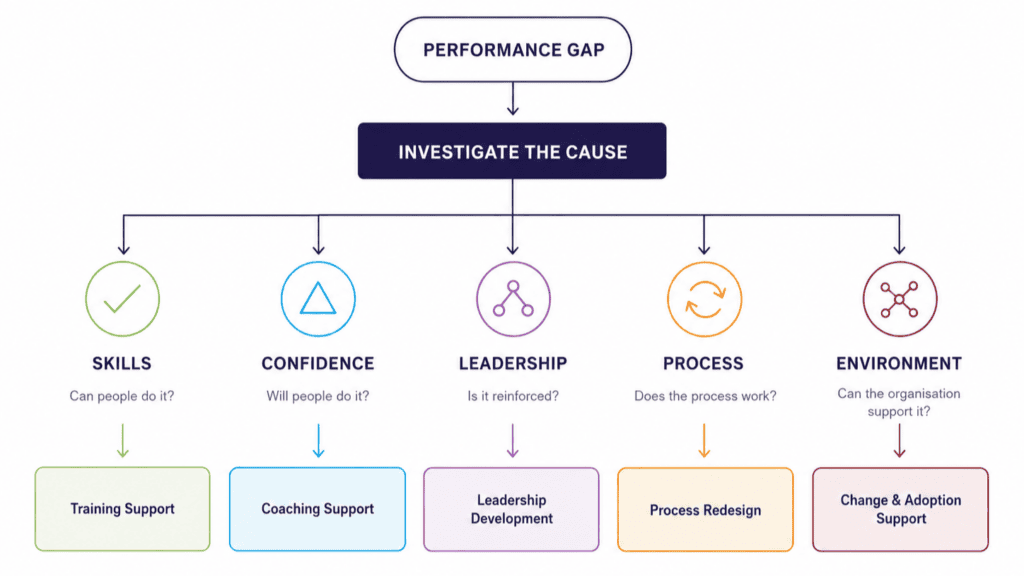
For example, employees may know how to use an AI tool and have completed the required training, but still choose not to use it in their day-to-day work. The underlying issue may be a lack of confidence, uncertainty about acceptable use or concerns about accuracy rather than a gap in technical knowledge. As we explored in our article on why learning is the real enabler of AI adoption, organisations often discover that capability development and continuous learning are bigger constraints than the technology itself.
5. Design Targeted Interventions
Only once root cause is understood should intervention design begin and training should be treated as one possible response among several, not the default choice. Depending on what step four reveals, the right intervention might be coaching, leadership development, process redesign, change support or a combination of these alongside training. An intervention plan built this way ensures investment is focused on the factors genuinely limiting performance, rather than on assumed training needs.
Turning learning needs into targeted capability support
500+
impacted users
1,300+
unique interactions with the messaging hub
10,000+
views, with 90% returning users
The challenge: A life sciences client needed to prepare 500+ people for a new product area, expanded role expectations and a future operating model for patient safety and regulatory reporting. Different audiences had different levels of understanding, relevance and learning preference, so traditional training alone would not create the engagement needed.
Afiniti’s contribution: Afiniti analysed impacted personas, current understanding and communication preferences, then created a blended learning strategy using bitesize content, role-relevant messaging and a central learning hub. The approach allowed people to engage with the right content at the right time, in a format that suited their role and experience level.
The difference: The learning experience generated over 1,300 unique interactions and more than 10,000 views, with 90% returning users. The assets built excitement, supported long-term rollout and became reusable across the programme, showing how targeted learning design can help turn capability needs into measurable engagement.
“I am grateful for the creative way Afiniti made our work shine through the sea of projects that are all vying for attention and share of mind.”
Principal Safety Director & Business Lead
Training Needs Assessment Template
A usable TNA template should capture evidence and decisions in one place, structured by the five steps above rather than as a loose set of questions. At minimum it should include:
- Business outcome and strategic link
- Current state evidence, by data source
- Future state requirement
- Capability gap statement, specific and measurable
- Root cause classification: skills, process, leadership, adoption, tooling
- Recommended intervention and rationale
- Success metric and review point
Using a standard template across the board helps ensure assessments are carried out consistently, with the same evidence and decision-making criteria applied each time.
Training Needs Assessment Template
Building Capability Instead of Delivering Training
Knowledge transfer and capability building are often treated as the same thing, but they achieve very different outcomes. When organisations focus only on transferring knowledge, they often fail to create lasting changes in performance
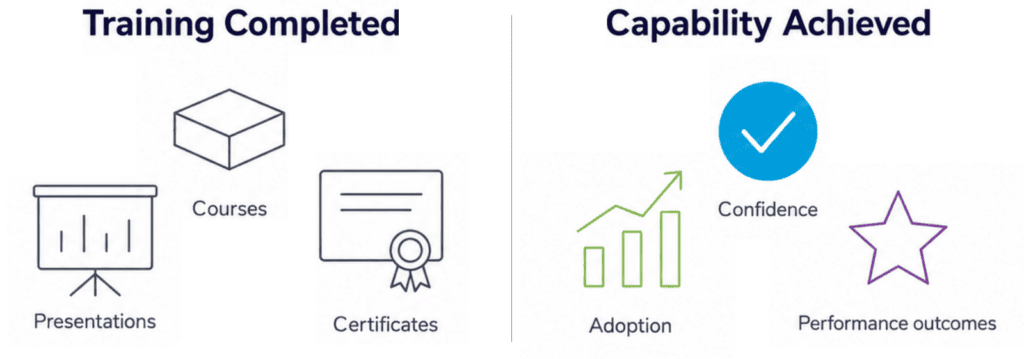
Confidence, behaviour change and reinforcement are the components that separate the two. Completing training is only the first step. Lasting performance improvement comes when people have the confidence to apply what they have learned, receive reinforcement from leaders and can put new skills to use in their day-to-day work.
Organisations that are serious about closing capability gaps, particularly around AI adoption and digital transformation, are increasingly using structured, outcome-linked programmes rather than one-off courses.
Build capability beyond traditional training
Our Change 101 Bootcamp helps leaders build the skills, confidence and behaviours needed to support successful change and adoption.
How to Measure the Success of a TNA
The success of a training needs assessment should never be measured by training completions or attendance figures, because those numbers do not show whether performance improved. The measures that matter connect back to the business outcome defined in step one of the process. This focus on performance outcomes is important because capability gaps have a measurable business impact. The UK Employer Skills Survey 2024 found that 65% of employers with skills gaps reported an effect on business performance, including increased workloads, higher operating costs and difficulties meeting quality standards.
Meaningful success indicators include:
- Adoption metrics for new tools, systems or ways of working
- Observed behaviour change in the specific area the gap was identified
- Performance improvement against the metric the intervention targeted
- Productivity movement in the relevant team or function
- Confidence levels reported by employees and validated by managers
- Leadership effectiveness in reinforcing the desired behaviour over time
Training Needs Assessment and Change Management ROI
This is also where training needs assessment connects directly to change management ROI. A transformation programme’s return depends on adoption and sustained behaviour change, not on whether training was delivered. A TNA that correctly identifies root cause and matches it to the right intervention protects that return, because budget is spent closing the gap that is actually limiting performance rather than the gap that was assumed. Executives evaluating change management ROI should expect the TNA output and post-intervention measurement to form part of that calculation, not sit alongside it as an afterthought.
Common Mistakes Organisations Make
We have seen several patterns recur across organisations that get less value from their training needs assessments than they should:
- Starting with a training solution before completing a proper diagnosis
- Running the assessment disconnected from any stated business outcome
- Focusing only on technical skills while ignoring process, leadership and confidence
- Failing to assess readiness for change alongside capability
- Not measuring impact after the intervention, so the same gap resurfaces later
Each of these mistakes is avoidable and each one tends to compound the others. An assessment run without a business outcome is more likely to default to technical skills as the easy answer, which in turn makes impact measurement difficult because there was never a clear target to measure against.
A practical starting point is to choose one priority business outcome and work backwards. Identify the performance gap, gather evidence from at least three sources and test whether the barrier is skill, confidence, process, leadership or environment before designing any training activity.
Building Capability That Drives Performance
A training needs assessment, when done properly, helps organisations understand what is limiting performance and where people need support as ways of working continue to evolve. AI adoption in particular is turning capability assessment into a continuous exercise rather than a periodic one; the pace of change means learning needs are becoming less predictable and less closely tied to individual projects.
Organisations that treat training needs assessment as an ongoing practice, rather than a one-off exercise, are more likely to keep capability aligned with changing business priorities.
Where to start
If you’re not sure whether the challenge is capability, confidence, leadership support or change readiness, our free online change readiness assessment helps identify the factors most likely to affect adoption and performance before you invest in solutions.
Training Needs Assessment FAQs
A training needs assessment is a structured process for identifying the gap between an organisation’s current performance and the performance it needs to achieve its goals and for recommending the right intervention to close that gap.
The three levels are organisational, which looks at strategic capability against business goals; team or operational, which looks at process effectiveness and functional capability; and individual, which looks at knowledge, skills, confidence and behavioural barriers.
A skills gap analysis focuses specifically on missing knowledge or skills. A training needs assessment is broader, considering performance data, working conditions, leadership and change readiness and recommends solutions rather than only confirming a gap.
Ideally before a performance problem becomes visible and specifically ahead of digital transformation, ERP implementation, AI adoption, organisational restructuring, new leadership appointments or the introduction of new performance metrics.
By gathering performance evidence from multiple sources, surveys, interviews, workshops, metrics and observation, then comparing current state against the future state required by a defined business outcome and testing the root cause of any gap found.
No. Many performance gaps are caused by unclear processes, low confidence, weak leadership reinforcement, inadequate tools, or resistance to change. Training should be one option considered after root cause analysis, not the automatic first response.
A training needs assessment focuses on identifying performance gaps and deciding whether training is the right response. A learning needs assessment is closely related, but often looks more broadly at what people need to learn or develop, which may include training, coaching, mentoring, self-directed learning or on-the-job practice. The terms are sometimes used interchangeably, so the most important point is to link any identified need to business outcomes and test whether training is the right solution before designing an intervention.