


Change Leadership: The Essential Guide for Senior Executives Driving Transformation
Leading through change is a defining challenge for any modern executive. Without the ability to change, an organisation cannot reach the top of its industry or remain there. Markets shift, technologies mature, regulations evolve and customer expectations move faster than most operating models were designed to handle. The common thread across organisations that navigate this well is leadership.
Change leaders serve as the primary sponsors of change, typically initiating transformation efforts and ensuring successful delivery and embedding. This spans board-level and C-suite executives driving major transformations like mergers and acquisitions through to senior managers steering smaller-scale, lower-risk initiatives. Leaders provide the resources, strategic importance and organisational credibility that change programmes require to succeed.
Leading change effectively demands working collaboratively towards a shared understanding of strategic goals and the specific changes required to achieve them. The challenge lies in execution: many change programmes fail, and ineffective change leadership represents the primary cause. Our 6LeverTM change readiness assessment tool consistently reveals this pattern; leadership receives the highest benchmark score of any lever whilst simultaneously recording amongst the lowest actual performance scores across organisations.
This gap between expectation and reality raises a fundamental question: what constitutes change leadership, and why do so many leaders struggle to deliver it effectively?
What is the difference between change management and change leadership?
Change management and change leadership represent complementary yet distinct disciplines, each playing essential roles in transformation success.
Change management focuses on structured processes and methodologies. It addresses how people adopt and use changes through systematic approaches. Change specialists, project managers and operational managers collaborate to engage employees, develop detailed implementation plans and track progress against defined metrics. This discipline provides the tactical map, steering the organisation through the specific steps required for transformation. Think of it as the detailed navigation that ensures everyone reaches the destination safely.
Change leadership operates at a different level entirely. It centres on visionary direction, igniting the cultural and mindset shifts necessary to realise strategic vision. This requires active, visible sponsorship from senior leaders who set direction and model desired behaviours. Change leadership provides the strategic compass, charting the course towards ambitious futures. Where change management answers “how do we implement this change?”, change leadership answers “why are we changing and where are we going?”.
| Dimension | Change Management | Change Leadership |
| Primary Focus | Structured processes and implementation | Vision, culture and strategic direction |
| Key Question | How do we implement this change? | Why are we changing and where are we going? |
| Timeframe | Tactical, project-focused | Strategic, long-term transformation |
| Key Activities | Planning, tracking, measuring adoption | Inspiring, modelling, building coalitions |
| Primary Stakeholders | Change specialists, project managers, employees | Senior executives, board members, leadership teams |
| Success Metrics | Adoption rates, timelines, budget adherence | Cultural shift, strategic alignment, sustained behaviour change |
| Metaphor | The map and steering wheel | The compass and destination |
| Nature | Methodical and systematic | Visionary and inspirational |
Organisations need both the compass and the map. Without clear leadership direction, even the most sophisticated change management processes become exercises in managing the wrong changes well. Without robust change management processes, even the most compelling vision struggles to translate into sustained organisational reality.
Types of Change Leaders and Their Roles
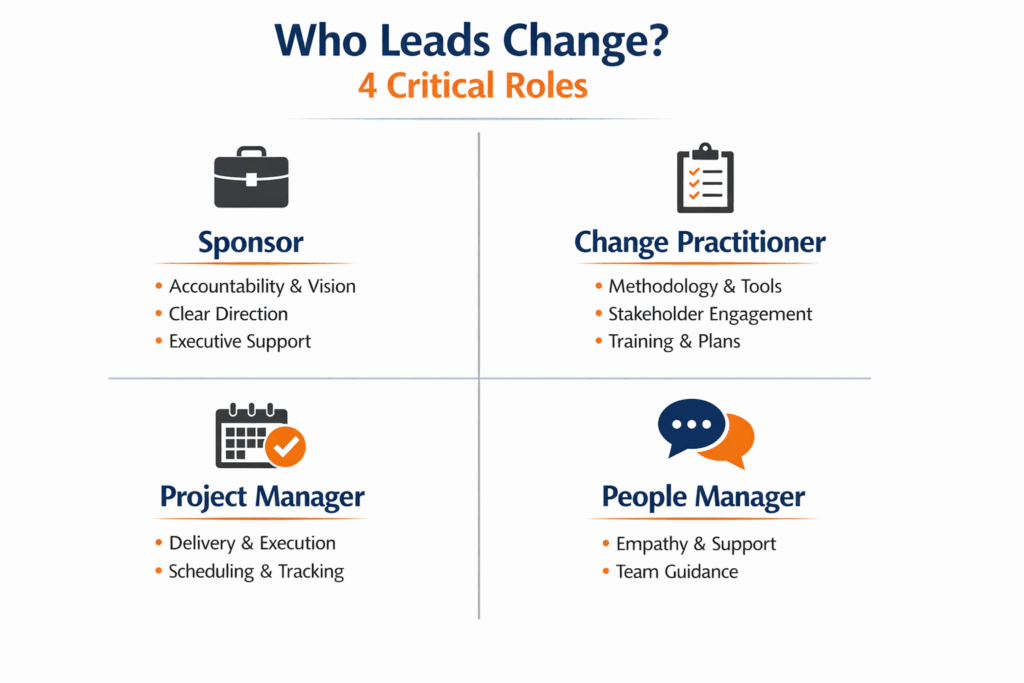
Change leadership involves multiple distinct roles, each contributing essential capabilities to transformation success. These roles may overlap in smaller organisations or those with less mature change capabilities, yet understanding the distinctions helps clarify accountability and expectations.
Sponsors
Senior executives who authorise, initiate and remain accountable for transformation initiatives. Effective sponsors maintain active, visible presence throughout the change lifecycle rather than simply approving business cases then disappearing. They communicate direction clearly, build support across all organisational levels and remove obstacles that impede progress.
Most significant changes require a primary sponsor, typically a C-suite executive with ultimate accountability, supported by a coalition of sponsor peers. These leadership coalitions cascade change efforts through their respective functions, regions or business units, translating enterprise-level transformation into contextually relevant priorities for their teams.
Change Practitioners
Change management specialists who coordinate change activities, develop comprehensive strategies and detailed implementation plans. These professionals bring methodological rigour, having typically studied change models like ADKAR, Kotter or Prosci. They coach sponsors and managers on change leadership practices, assess organisational readiness, design communication strategies and measure adoption progress.
Change practitioners serve as the connective tissue between strategic vision and operational reality, ensuring that inspirational leadership intent translates into systematic employee engagement.
Project Managers
Professionals handling the technical implementation aspects of change programmes. They manage timelines, budgets, resource allocation and delivery milestones for system implementations, process redesigns or infrastructure changes. Whilst project managers focus on “building the thing right”, they must collaborate closely with change leaders and practitioners to ensure that technical solutions align with business objectives and adoption realities.
People Managers
Direct line managers who guide employees through day-to-day impacts of transformation. They translate strategic messages into practical implications for their teams, address concerns, provide emotional support and feed back implementation challenges to senior leaders. People managers occupy the critical middle ground where organisational strategy meets individual experience.
Research consistently demonstrates that employees rate their direct managers as the most trusted source of information about change impacts. This positions people managers as essential change leaders regardless of their formal involvement in transformation governance structures.
The Risks of Inadequate Change Leadership
Poor change leadership creates cascading organisational failures that extend far beyond missed project milestones. When leadership commitment proves insufficient, change initiatives inevitably slide down strategic priority lists. Without visible champions at senior levels, competing priorities consume the attention and resources that transformation requires.
This leadership vacuum generates fear, confusion and active resistance. Employees question the change’s legitimacy when senior leaders fail to model new behaviours or communicate consistently. Ambiguity about expected changes or anticipated benefits breeds anxiety, reducing productivity and increasing attrition risk amongst high performers who refuse to tolerate uncertainty.
Resistance intensifies when employees perceive leadership hypocrisy, observing that senior executives exempt themselves from the very changes they mandate for others. This credibility gap makes subsequent engagement efforts exponentially more difficult.
The financial and operational consequences prove severe: project delays, significant budget overruns and diminished return on investment. In worst-case scenarios, organisations invest millions in transformation initiatives that fail to embed sustainably, reverting to legacy processes within months of formal completion dates.
Understanding these risks raises the critical question: what distinguishes effective change leaders from their ineffective counterparts?
Foundations of Effective Change Leadership
Articulating Purpose
Successful change leaders relentlessly communicate the purpose and benefits of transformation, connecting change initiatives to organisational values and strategic vision. This creates genuine buy-in, desire for change and psychological ownership amongst stakeholders.
This communication should commence during business case development, with leadership support established as early as possible. The compelling “why” (your change’s North Star) must remain visible throughout the transformation lifecycle, consistently reinforced and explicitly aligned to wider business strategy.
Generic rationales like “staying competitive” or “improving efficiency” fail to inspire. Effective change leaders craft specific, emotionally resonant narratives that connect transformation to meaningful outcomes for the organisation, customers and employees themselves. They answer “what’s in it for me?” honestly for every stakeholder group.
Building Coalitions
Transformation cannot succeed in silos. Change leaders must align and unite stakeholders with competing priorities, conflicting functional objectives and divergent regional concerns. This includes fellow executives across functions, business unit leaders and importantly, frontline employees whose input shapes practical implementation decisions.
This coalition-building requires political acumen, negotiation skills and genuine commitment to inclusive decision-making. Leaders who attempt to drive change through hierarchical mandate alone inevitably encounter resistance that derails implementation. Those who invest time building consensus and shared ownership create sustainable momentum that withstands setbacks.
Demonstrating Personal Commitment
Change leaders must commit significant time and genuine belief to transformation initiatives, often stepping outside comfort zones to develop new capabilities or engage in challenging conversations. They become the first to embrace changes, role-modelling desired behaviours with active, visible engagement.
This visibility matters profoundly. Employees observe leadership actions more carefully than they listen to leadership words. When senior executives attend training sessions alongside employees, actively use new systems despite initial inefficiency or publicly acknowledge mistakes whilst adapting, they provide powerful proof that change is serious, safe and achievable.
Leaders who delegate change ownership to their teams whilst maintaining comfortable distance from implementation send unmistakable messages: this change lacks genuine priority and carries career risk. Which could be why 31% of CEOs who were fired lost their jobs primarily due to poor change management.
Developing Robust Change Strategies
Strong change leaders develop comprehensive strategies and roadmaps that include clear milestones, realistic timelines and adequate resource allocation. They maintain relentless focus on what success will look like, defining specific, measurable outcomes rather than activity-based metrics.
This strategic thinking extends beyond project plans to encompass organisational readiness assessments, stakeholder impact analyses, risk mitigation strategies and detailed communication frameworks. Leaders who treat change as simply “getting people to do things differently” underestimate the complexity and consequently under-invest in critical success factors.
Operationalising Strategy
Strategy development means nothing without effective operationalisation, yet this represents one of the largest gaps causing change failure. Transforming ambitious vision into daily operational reality requires breaking large initiatives into smaller, manageable components that deliver quick wins and build momentum.
Our SIMPLETM framework provides structured approaches for this operationalisation.
Leaders skilled at operationalisation translate abstract strategies into concrete action plans, assign clear ownership, establish transparent accountability and maintain consistent focus despite competing pressures.
Fostering Adaptability
As change becomes faster and more frequent, change leaders must encourage organisational adaptability, intellectual curiosity and honest two-way communication about both successes and failures. Rigid, phase-gated approaches that worked for occasional, major transformations prove inadequate for environments requiring continuous evolution.
This demands embracing agile practices: iterative development, rapid experimentation, tolerance for intelligent failure and willingness to pivot when evidence suggests alternative approaches. Leaders who punish failures whilst demanding innovation create contradictions that paralyse organisations.
Mastering Communication
Employees value change messaging from both direct managers and senior leaders, each providing distinct yet complementary perspectives. Direct managers communicate practical, day-to-day impacts, answering immediate questions about workflow changes, skill requirements and performance expectations. Senior leaders communicate holistic, strategic messages that connect individual changes to organisational vision and competitive positioning.
Effective change communication demonstrates three critical qualities: authenticity, engagement and transparency. Authentic communication acknowledges legitimate concerns rather than dismissing them, admits uncertainties whilst committing to ongoing dialogue and demonstrates genuine empathy for disruption imposed on employees. Engaged communication moves beyond impersonal email announcements to include face-to-face conversations, town halls with genuine discussion and active presence in workplaces during implementation.
Transparent communication shares both positive and negative information openly, explaining the reasoning behind difficult decisions and acknowledging when outcomes fall short of expectations. This transparency builds trust that proves essential when organisations request significant changes in employee behaviour, skills or mindset. Especially important when you consider 41% of employees cite mistrust in the organisation as the top reason for resisting change.
Skilled storytelling represents a particularly valuable communication strength for change leaders. Compelling narratives about transformation journeys (why they started, challenges encountered, breakthrough moments and ultimate destinations) resonate emotionally in ways that business cases and project plans never achieve.
Putting People at the Heart
Leaders must keep people at the heart of transformation throughout the entire change lifecycle. Engaging everyone involved or impacted mitigates resistance to change. This requires both empathy and practical support.
Empathy means acknowledging the psychological and emotional impacts of change, particularly when transformation disrupts comfortable routines, threatens job security or demands significant personal adaptation. Emotional support might include coaching, peer support networks or simply creating safe spaces for employees to express concerns without fear of judgment.
Practical support centres on competency and capability development, ensuring that people possess the skills, knowledge and resources required to thrive in future states rather than merely survive them. This might involve comprehensive training programmes, ongoing coaching, job aids and performance support tools.
When organisations invest genuinely in helping people succeed through change rather than simply imposing change upon them, securing buy-in and sustained support becomes dramatically easier. This applies equally to leadership peers who may resist transformation that threatens their established power bases or expertise.
Committing to Continuous Learning
Effective change leaders recognise that no two transformations prove identical. Market contexts differ, organisational cultures vary and technological capabilities evolve. This diversity demands that leaders continually build their own change leadership capabilities rather than relying on approaches that succeeded previously.
Continuous learning involves actively seeking feedback from all levels, studying transformation outcomes rigorously to understand success factors and failure modes, experimenting with emerging change methodologies and building relationships with other transformation leaders to share insights. Leaders who assume their experience alone suffices for future challenges risk repeating dated approaches in fundamentally changed contexts.
Characteristics That Define Exceptional Change Leaders
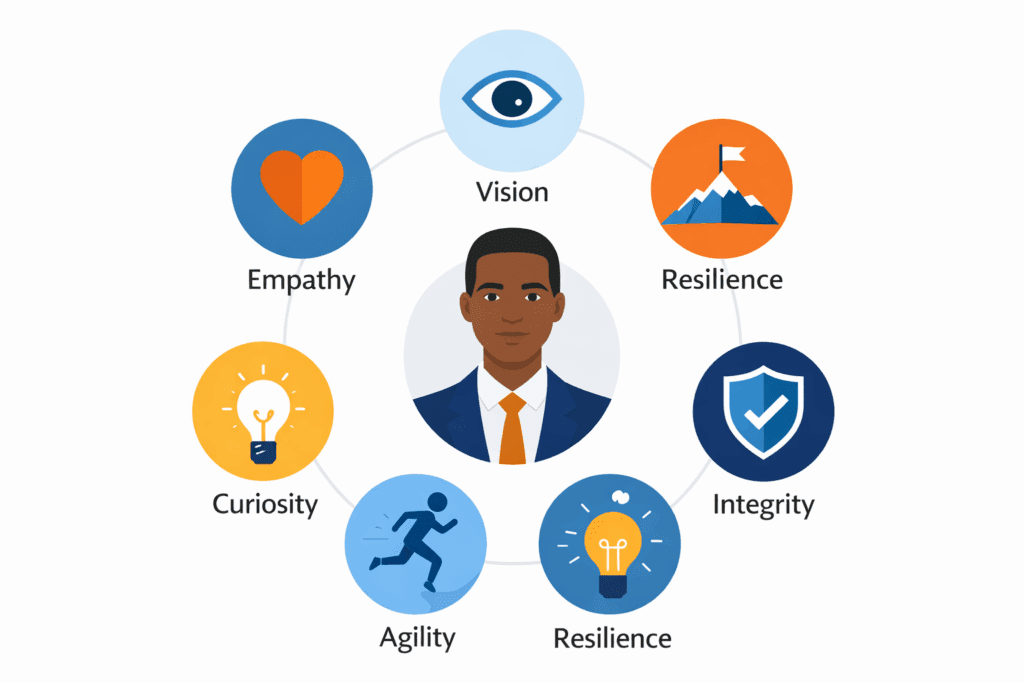
Effective change leadership requires cultivating specific personal characteristics alongside technical skills and methodological knowledge. These traits enable leaders to navigate the human complexity of transformation alongside the technical and operational challenges.
Empathy and emotional intelligence
Leaders need to listen carefully to concerns, understand diverse perspectives and provide appropriate support during difficult transitions. Emotionally intelligent leaders recognise when resistance signals legitimate concerns requiring attention rather than simple obstinacy requiring pressure.
Flexibility
Enables moving fluidly between competing priorities, seniority levels and functional contexts. Transformation rarely proceeds linearly. Leaders must adjust strategies based on emerging evidence, shift resources to address unexpected obstacles and tailor approaches to different stakeholder groups whilst maintaining strategic coherence.
Agility
Encompasses moving quickly, learning from failures without fear and maintaining forward momentum. Agile leaders experiment, prototype and iterate rather than pursuing perfection before launching. They view setbacks as learning opportunities rather than career-threatening failures.
Focus
Ensures change maintains priority against relentless pressures from business-as-usual operations. Without discipline and intentionality, transformation initiatives become perpetually deprioritised beneath quarterly targets, customer escalations and operational fires. Focused leaders protect change investments through consistent attention and resource commitment.
Resilience
Proves essential because change is genuinely difficult, generating resistance from all organisational levels and encountering inevitable setbacks. Resilient leaders persevere through challenges, maintain optimism without denying reality and recover quickly from disappointments whilst helping others do the same.
Curiosity
Drives continuous improvement and innovation. Curious leaders never stop seeking better approaches, questioning assumptions or exploring how other organisations tackle similar challenges. They read broadly, attend conferences, build diverse networks and encourage experimentation throughout their organisations.
Visionary thinking
Enables seeing beyond current reality to imagine unique, competitive future states. Visionary leaders articulate compelling pictures of achievable futures that inspire others whilst taking reasonable risks to pursue ambitious outcomes. They balance pragmatism with aspiration, grounding vision in evidence whilst refusing to limit ambition to safe, incremental improvements.
Enthusiasm and charisma
Create the energy required to champion change and authentically inspire others. Enthusiastic leaders generate excitement about possibilities rather than simply mandating compliance. Their genuine passion proves contagious, helping stakeholders see opportunities where they previously perceived only threats and disruption.
Authenticity and integrity
Establish the trust foundation that all successful change requires. Honest, transparent communication about challenges and uncertainties builds credibility that survives setbacks. Leaders who demonstrate integrity through consistency between words and actions earn permission to ask for significant commitments from their teams.
How can managers lead effectively through change and uncertainty?
As transformation becomes more frequent and distributed throughout organisations rather than remaining solely the domain of senior executives, people managers require many of these same change leadership capabilities. Their primary focus necessarily centres on helping direct reports navigate day-to-day impacts of change rather than setting strategic direction, yet their role proves equally critical to success. However, 74% of HR leaders believe their managers lack the skills to lead change effectively.
People managers must communicate change effectively within their teams, translating enterprise-level messages into locally relevant context. They champion change by demonstrating personal commitment and enthusiasm despite their own potential concerns. They role-model new behaviours, showing teams that adaptation is both possible and beneficial rather than simply mandated.
Crucially, effective people managers create feedback loops upward to their own leaders, surfacing implementation challenges, resistance patterns and improvement opportunities that senior leaders rarely observe directly. This feedback proves essential for adaptive strategy refinement that addresses real rather than assumed barriers.
Many people managers need specialist change support to fulfil these responsibilities effectively. Few receive training in change leadership as part of management development programmes, yet organisations expect them to guide teams through complex, emotionally challenging transitions. Providing coaching, toolkits and ongoing support for people managers represents high-leverage investment that dramatically improves transformation outcomes.
The Evolving Future of Change Leadership
Looking ahead, several trends will reshape change leadership requirements and expectations across organisations of all sizes and sectors.
Change Leadership as Core Competency
The increasing volatility, uncertainty, complexity and ambiguity of business environments means change leadership evolves from specialised capability into core competency for all managers and leaders. Organisations can no longer afford change leadership residing exclusively amongst C-suite executives or specialist practitioners. Every leader at every level requires change leadership fluency to guide their teams through continuous evolution.
This shift demands fundamental changes in leadership development programmes, performance expectations and promotion criteria. Organisations should assess change leadership capabilities systematically during hiring and advancement decisions, invest in building these skills across leadership populations and celebrate change leadership excellence visibly.
Human-Centred Leadership for Digital Transformation
Paradoxically, as digital technologies and artificial intelligence drive increasing proportions of organisational change, human-centred leadership becomes more rather than less critical. Technology implementations fail predominantly through inadequate attention to human factors: resistance to workflow changes, insufficient training, poor change communication and inadequate stakeholder engagement.
Change leaders driving digital transformation must balance technical enthusiasm with deep empathy for human impacts. They need to anticipate how automation affects job security concerns, how new systems disrupt established expertise and status hierarchies and how rapid technological evolution creates continuous learning demands that exhaust employees.
From Change Leaders to Transformation Leaders
Tomorrow’s most effective change leaders may need to reconceptualise themselves as transformation leaders focused on achieving lasting, wide-reaching change by fundamentally shifting cultures, mindsets and behaviours. Rather than viewing their role as successfully delivering discrete change initiatives, transformation leaders think holistically about how multiple changes interconnect to advance strategic vision.
This perspective proves essential as change initiatives become more frequent yet smaller in individual scope. Without coordinated transformation leadership, organisations risk initiative fatigue, where employees experience change as chaotic whiplash between disconnected projects rather than coherent strategic evolution. Transformation leaders provide the unifying narrative and strategic coherence that makes continuous change sustainable and meaningful.
This transformation leadership demands even greater emphasis on visionary, inspirational approaches that connect individual changes to compelling future states. It requires sophisticated systems thinking that recognises interdependencies between initiatives and sophisticated change orchestration that sequences and paces changes for maximum adoption whilst minimising disruption.
Emotional intelligence becomes increasingly critical as transformation leaders navigate the psychological impacts of perpetual change, helping employees maintain resilience, adaptability and engagement despite ongoing uncertainty and evolution.
Embracing the Change Leadership Imperative
Change leadership presents genuine difficulty not only for those experiencing transformation but equally for those leading and driving it. The capabilities required extend beyond traditional management competencies into realms of visionary thinking, emotional intelligence, strategic communication and resilient perseverance.
Yet organisations face inescapable reality: effective change leadership separates successful transformation from expensive failure. The quality of change leadership predicts initiative outcomes more reliably than strategy quality, technology sophistication or resource availability. Poor change leadership dooms even well-designed transformations whilst exceptional change leadership salvages initiatives facing significant obstacles.
The encouraging news is that change leadership represents learnable capabilities rather than innate traits. Leaders can develop empathy, build communication skills, learn agile practices and cultivate resilience through deliberate effort and practice. Organisations can systematically assess change leadership capabilities, invest in developing them and create environments where effective change leadership flourishes.
Our Change 101 Bootcamp gives leaders the tools, shared language and hands-on experience to lead change with greater confidence and consistency.
Those leaders who commit to developing change leadership excellence position themselves and their organisations for sustained success in environments defined by accelerating change. They become architects of futures rather than administrators of present reality, guiding their teams confidently through uncertainty towards compelling visions of what their organisations can become.
The choice facing today’s leaders proves straightforward if not easy: develop change leadership capabilities commensurate with transformation challenges, or watch competitors led by more capable change leaders define your industry’s future without you.
Get in touch
For coaching and advisory support for your change leaders, get in touch with our experienced team of business, change and domain leaders today.
Change Leadership Frequently Asked Questions
Change leadership is the practice of inspiring and guiding organisations through transformation by setting strategic direction, building coalitions and modelling desired behaviours. Unlike tactical change management, it focuses on vision: articulating why transformation matters, creating urgency and maintaining visible commitment throughout the journey.
Effective change leaders serve as primary sponsors, providing resources, credibility and organisational importance whilst engaging both hearts and minds to sustain momentum.
Change management focuses on structured processes and tactical implementation—how people adopt and use changes. Change specialists, project managers and managers work together to engage employees, develop plans and track adoption. Think of it as the map: detailed navigation through transformation steps.
Change leadership centres on visionary direction and strategic inspiration—why we’re changing and where we’re going. It ignites cultural and mindset shifts, requiring active sponsorship from senior leaders. This is the compass: charting the strategic course.
The distinction: Change management steers the ship; change leadership charts the course. Both are essential—leadership without management lacks implementation rigour, management without leadership lacks strategic direction.
Managers lead effectively through five critical practices:
Communicate consistently. Translate strategic messages into practical team implications. Employees trust direct managers most for day-to-day change impacts.
Role-model new behaviours. Be first to embrace changes. Your team watches your actions more than your words.
Provide support. Acknowledge psychological impacts whilst offering concrete help: coaching, training, resources and safe spaces to express concerns.
Create feedback loops. Surface implementation challenges and resistance patterns to senior leaders for adaptive refinement.
Maintain focus. Protect change initiatives from being deprioritised by business-as-usual pressures through consistent attention.
Many managers need specialist change support to fulfil these responsibilities effectively.
Change leaders serve five critical functions:
Strategic sponsor: Authorises transformation, provides resources and removes obstacles with active, visible presence.
Vision communicator: Articulates compelling reasons for change connected to organisational values, answering “what’s in it for me” for every stakeholder.
Coalition builder: Aligns diverse stakeholders across functions and levels. Change cannot succeed in silos.
Behaviour model: Demonstrates new behaviours first, showing teams that adaptation is safe and achievable.
Culture catalyst: Ignites mindset shifts required to embed transformation permanently beyond technical implementation.
Primary accountability: ensuring transformation delivers strategic outcomes and embeds sustainably.
Good change managers combine technical competency with emotional intelligence:
Methodological expertise: Deep knowledge of change frameworks (ADKAR, Kotter, Prosci) and ability to assess readiness, analyse stakeholders and measure adoption.
Communication excellence: Translates complex strategies into clear, actionable plans with compelling narratives for diverse audiences.
Empathy: Understands the human experience of change, acknowledges concerns and provides appropriate support during transitions.
Analytical rigour: Uses data to track progress, identify needs and demonstrate return on investment.
Influence without authority: Coaches sponsors and builds relationships across boundaries, securing commitment through credibility.
Adaptability: Adjusts approaches based on evidence and feedback whilst maintaining strategic coherence.
Key differentiator: exceptional change managers bridge vision and reality, translating leadership intent into sustainable behaviour change.
Microsoft’s cultural transformation under Satya Nadella demonstrates exemplary change leadership. When Nadella became CEO in 2014, Microsoft faced declining relevance and a competitive internal culture.
Vision: Articulated “mobile-first, cloud-first” strategy whilst shifting from “know-it-all” to “learn-it-all” culture, connected to purpose: “empowering every person and organisation to achieve more.”
Personal modelling: Visibly embraced growth mindset, publicly acknowledged mistakes and demonstrated vulnerability. Changed leadership composition and reformed performance management.
Strategic focus: Prioritised Azure and Teams, divesting lower-priority initiatives. Maintained consistent focus despite short-term pressures.
Cultural embedding: Reinforced new values through reward structures and accountability frameworks.
Results: Market capitalisation grew from £230 billion to over £2 trillion, Azure became second-largest cloud platform and employee engagement improved dramatically.
Key lesson: effective transformation requires both visionary direction (the compass) and systematic implementation (the map).